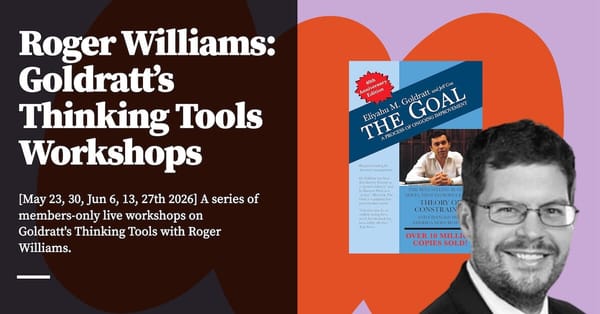
May 23, 30, Jun 6, 13, 20 2026 8am-9am EDT / 8pm-9pm SGT. Roger Williams teaches how he uses Eliyahu Goldratt’s Thinking Tools.
I'm pleased to announce a live Commoncog members-only workshop on Eliyahu Goldratt's Thinking Tools by Commoncog member Roger Williams.
A few weeks ago, in the Commoncog forums, Roger Williams kindly offered to do a series of live workshops, to share how he uses Goldratt's Thinking Tools. (He also mentioned that he had been vibe-coding a bunch of tiny tools to make his process easier). A number of members were immediately interested.
What are these Thinking Tools, and who is Eliyahu Goldratt?
What Are Goldratt's Thinking Tools?
Eliyahu Goldratt was an Israeli management guru who is most famous for publishing the 1984 business novel The Goal, which introduced the Theory of Constraints (ToC). Goldratt developed the 'Thinking Tools' alongside ToC between 1988 to 1994 — a set of integrated problem-solving tools designed to answer three questions:
- What to change?
- What to change to?
- How to cause the change?
One of the more remarkable stories told about the tools comes from the tale of Sheila Taormina, who was a competitive swimmer who had twice missed out on making the Olympic team (in 1988 and 1992), and was passing her prime. She took a business class where the professor assigned students to use ToC for a personal productivity project. She chose improving her swimming time as her project.
Going into the 1996 cycle, Taormina was 160cm (incredibly short for a short distance swimmer, where average heights for the 200m event are 178cm, or 5'10"), was 23 years old, and had no real performance record at the international level.
Then as now, there was widespread consensus on the 'ideal' body type to be a world class swimmer. But the proof of the pudding was in the eating, and her swimming times just weren't good enough.
Taormina filled 11 pages when drawing the various 'trees' of the Thinking Tools (each of them a kind of cause-and-effect diagram). Note that there are five thinking tools, and Taormina went through all of them:
- The Current Reality Tree (CRT) — which contains cause-and-effect boxes and diagnoses what's broken.
- The Evaporating Cloud (EC) — which surfaces the underlying conflict that keeps the root cause in place. The output here is an 'injection' — a change that gets at dismantling the underlying conflict.
- The Future Reality Tree (FRT) — which imagines what the situation would look like after the injection, and asks the user to imagine potential bad side effects.
- The Prerequisite Tree (PT) — which works out the obstacles to actually executing the injection and orders the intermediate objectives.
- The Transition Tree (TT) — which is the action plan, or the concrete sequence of steps to get from your current state to each intermediate objective.
So what did Taormina do? As a result of the Thinking Tools exercise, she made a number of changes to her training routine. For instance, she stopped training when her body was broken down and tired (a counter-intuitive thing to do compared to the "more reps, more yards" instinct most competitive swimmers had at the time). And she also realised that while her aerobic fitness was excellent, her strength and power did not match her aerobic capability (she also noticed that her coaches kept getting her to do aerobic exercise). So she found a coach who was willing to experiment with her, executed the plan she outlined using the Thinking Tools and four years later qualified as an alternate for the 1996 4x200m team.
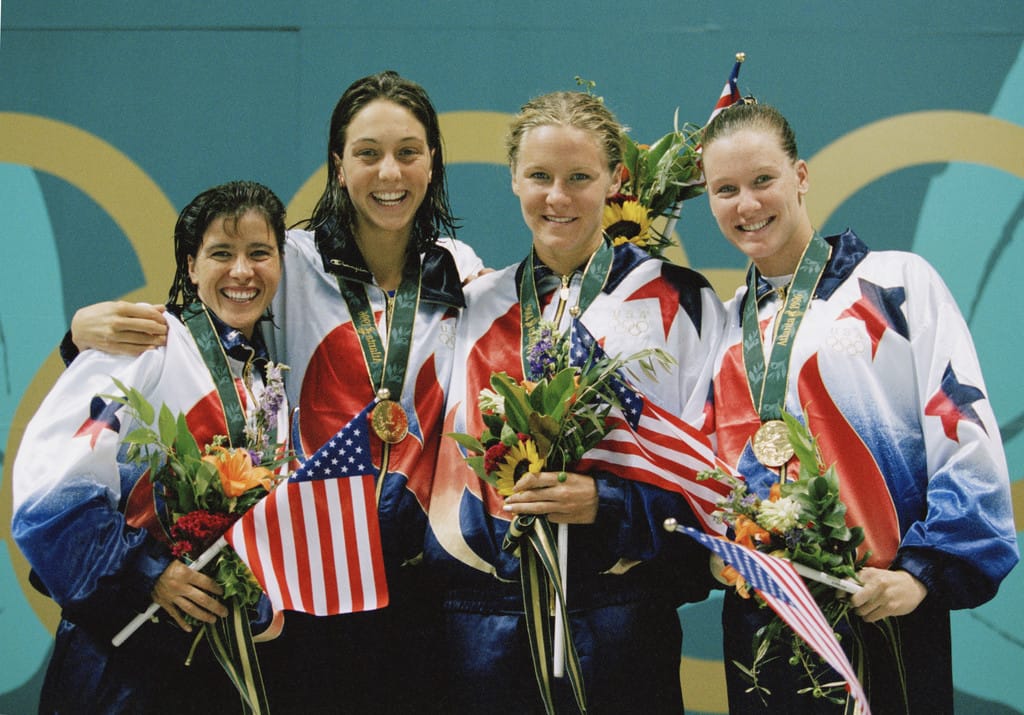
Taormina swam the third leg of the 4x200 free relay finals in Atlanta, between Cristina Teuscher (185cm) and Jenny Thompson (177cm). She earned her place only after swimming the fastest split in the morning prelims. The team won gold, and set a new Olympic record. Years later, Swimming World magazine would call her "the most unlikely member of the 1996 Olympic team".
She was, by far, the shortest swimmer on the podium.
She later came back to the Olympics as a triathlete, and then again — at age 39 — as a modern pentathlon athlete, in the process becoming the first woman to qualify for three different Olympic sports.
Workshop Details
Here are the details for the workshops:
- 23 May 2026 (and then May 30, June 6, 13, and
20th27th; five in total) - 8am-9am EDT / 8pm-9pm SGT (timezone visualisation here)
- We'll open the Zoom room 15 minutes before the start time and end precisely at the one hour mark.
- Format: Roger will dive deep into the core problem we've chosen to use as a demo, with the Thinking Tool of the week, and then at the 30 minute mark we'll open it up to the floor.
- The events will be recorded but made available only to members, so if you would like to discuss your personal self-improvement projects / business context, please be warned that there will be a recording!
Roger is envisioning this as a series of five workshops, one for each of the tools, held at the same time each week on May 23, 30, June 6, 13 and 20 27. The registration link below will sign you up for all five workshops, though you may choose to attend only some of them.
Do note that this is all experimental, and we'll likely adapt as we see what works!
Feel free to suggest potential business problems to dig into in this forum thread. If nothing good pops up, we'll use Commoncog itself as a business example.
Originally published , last updated .
Ideas and cases to accelerate business expertise
Commoncog is a publication dedicated to the serious study of business.
We are businesspeople serving other businesspeople. We develop methods to build business expertise, faster.
Your time is valuable. We publish only what we think is useful, tested, and good.
Sign up to receive our latest writing: