Case
How Amazon Survived the Dotcom Bust
Listen to this case (Technological Windows)
In May 1999, the weekly newspaper and magazine, Barron’s, featured a now infamous cover story titled “Amazon.bomb” with an accompanying illustration of Jeff Bezos’ face on a cartoon bomb ready to explode. “The idea that Amazon CEO Jeff Bezos has pioneered a new business paradigm is silly,” the article read. “He is just another middleman, and the stock market is beginning to catch on to that fact.”
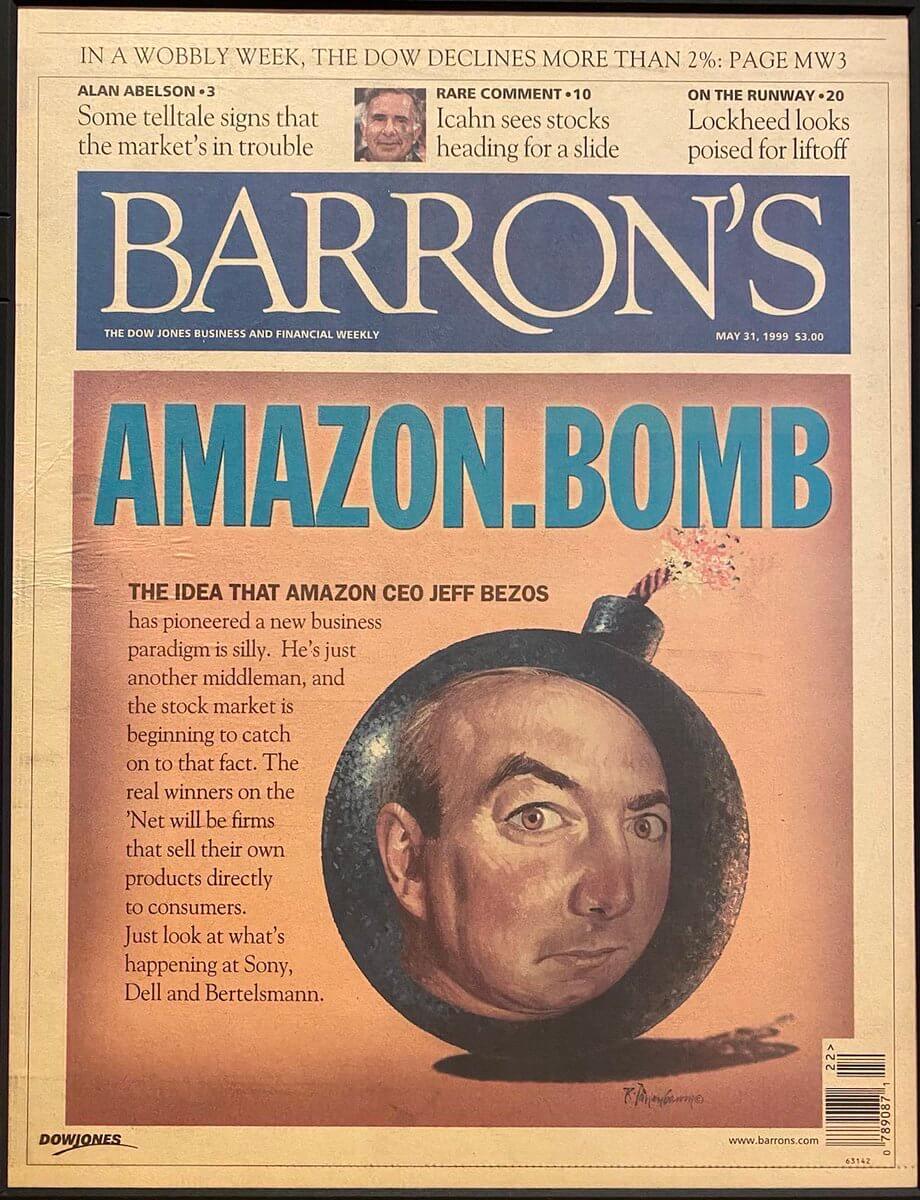
At the time, this was not a ridiculous pronouncement. In the late 1990s, the normal laws of business had been suspended for new internet companies. Investors seemed willing to buy the stock of any company with a dotcom suffix, sending market caps and stock prices soaring. Nobody, it seemed, paid any attention to whether the business was making a profit.
The most theatrical display of this absurdity was the 2000 Super Bowl, later known as the ‘Dot-Com Super Bowl’. Fourteen dotcom companies – and more internet related companies if you counted broadly – from Pets.com, OurBeginning.com, Epidemic.com, HotJobs.com and others, spent, on average, $2.2m each for a 30 second spot on the TV. OurBeggining.com, a company that printed wedding invitations, spent four times of what they made in sales in 1999 on the ads.
Most of these companies would either go bankrupt or be bought out before the end of that same year.
From the beginning of 1995 to its peak on 10 March 2000, the Nasdaq Composite rose by roughly 400%. It then fell nearly 78% by October 2002. By most accounts, Amazon looked like it belonged to the same crowd.
Amazon was burning through investor money, increasingly building warehouses to support its expansion into product categories far beyond its original domain of books. During 1998 and 1999, Amazon spent over $429m on its physical and digital infrastructure, linking distribution and customer service centres across the US, Europe, and Asia. By late 1999, this infrastructure had roughly 70-80% overcapacity.
Inside the company, the accounting team was nervous. The chief accounting officer at the time, Kelyn Brannon, warned Bezos that at their current rate, Amazon would not be profitable for decades.
Outside the company, analysts were making the problem public. In June 2000, working from Amazon’s latest quarterly filings, Ravi Suria, a 28-year-old analyst at Lehman Brothers, argued that the company would run out of cash within four quarters unless it raised more money or dramatically reduced their spending.
To sceptics, Amazon was another dotcom waiting to burst. To Bezos, this was all “pure unadulterated hogwash”.
Amazon and The Dotcom Boom
Amazon was founded in 1994. Jeff Bezos was a senior vice president at D. E. Shaw & Co, a quantitative hedge fund — he was the firm’s youngest SVP, at the mere age of 28. Whilst at the firm, he realised that this new-fangled thing called the Internet was growing at an insane rate — one report he read put the projected annual web commerce growth rate at 2,300%. Bezos quit D. E. Shaw, and moved across the country to Seattle, incorporating the company in July 1994. His goal was to build an online store that sold everything, but the first product category Amazon sold was books.
The earliest days were hardscrabble. Bezos worked out of a garage, along with Shel Kaphan, who built the first version of the Amazon.com web store. Kaphan spent nearly a year building the store from scratch in 1994, and then they spent a full year of beta testing in 1995. To kick things off, the first check into the company was Bezos’s own money, followed closely by his parents: according to a 1997 SEC filing, Bezos’s parents invested $245,573 — a big chunk of their life savings. Bezos told them there was a 70 percent chance they'd lose the whole investment, and they wrote the cheque anyway; his dad’s first question was reportedly, “What’s the Internet?”
Through 1995 and 1996 Bezos worked his network to raise roughly a million dollars from about twenty angel investors, mostly Seattle locals. One of them, stockbroker Eric Dillon, thought Bezos‘s $6 million valuation was pulled out of thin air and talked him down to $5 million before putting money in; another, venture capitalist Tom Alberg, was won over by Bezos’s projection that Amazon could turn over inventory 20 times a year versus the 2.7 typical for bookstores.
In 1996, Amazon raised a venture round. Kleiner Perkins beat out General Atlantic and others to lead it, closing $8 million at a $60 million valuation. John Doerr joined the newly formalised board when it closed. The numbers quickly justified everyone's bets — revenue went from about $500,000 in 1995 to just under $16 million in 1996, a 32-fold jump. In May 1997, Amazon went public, raising $54 million at a market value of around $438 million.
The IPO gave Amazon both cash on its balance sheet and publicly traded shares that it could issue as currency for acquisition. The company used that capital to invest in or acquire internet start-ups and expand into new categories. In 1998, for example, it acquired comparison-shopping company Junglee for about $170m in Amazon stock.
At the time, the stock market was already starting to froth.
Netscape went public in 1995, just 16 months after it was founded. The Netscape IPO, more than anything else, kicked off the dotcom boom. Netscape’s shares were priced at $28, opened at $71, peaked at $75, and closed the first day at double its IPO price at $58.25, valuing the young browser company at over $2b.
Netscape showed investors that a fast growing, still-unprofitable internet company could command an extraordinary valuation in the public market. The view was that, if a company grew fast enough and captured a large enough market, it would eventually become profitable.
Over the next few years, stories of dot-com companies racking up enormous first-day IPO gains went everywhere. Quickly, mom-and-pop investors began to pile in. Who cared what these companies did, the thinking went, so long as you could make a killing buying into the IPO? The folks who were sceptical became less so as the bubble wore on, as they saw friends making gobs of money buying dotcoms.
Yahoo went public in April 1996.its stock opened at $13 and ended at $33 on its first day of trading — a 154% gain. Yahoo’s stock price would rip over the next few years, eventually settling at a market valuation of over $100 billion at its peak in 2000.
theGlobe.com was founded in 1995 by Cornell students Stephan Paternot and Todd Krizelman. The company was, in a sense, a social networking website, where users could build personal pages and participate in online communities. In the first six months of 1998, the company reported only $1.2m in revenue and a loss of $5.8m. When it went public in November 1998, its shares were priced at $9, first traded at $87, reached $97, and closed at $63.50 — a 606% gain. It was, at the time, the largest first-day rise in IPO history, surpassing the record set only four months earlier by another dotcom startup, Broadcast.com.
CDNow, another online retailer that sold CDs and music-related products, went public in February 1998 at $16 a share, raising about $64.6 million. Its shares jumped into the $20 range on the first day even though the company had lost $10.7m on $17.3m in revenue the previous year.
Priceline.com, a company that quickly became popular selling unsold airline tickets online, went public in March 1999. On its first day of trading, investors chased the stock to a 331% premium over its offering price, giving the company a market value of $9.8 billion. Few investors were concerned that the company had incurred $116.9m in losses on a revenue of $35m in 1998.
So, Amazon’s IPO was in good company — it was a dotcom in a public market that was crazy about dotcoms.
The Turning Tides
By 2000, after five years of frenzy over dotcom IPOs, the atmosphere around internet companies was beginning to change. In March 2000 Barron’s published another cover story, “Burning Up”, this time warning that web companies were running through their capital too quickly.
Amazon’s shares, which had moved mostly upwards since the IPO, reached a high of $113 on 9 December 1999. The stock then traded down over the next 21 months.
In The Everything Store, Brad Stone chronicles Amazon’s story and describes that Amazon survived the dot-com bust through a combination of “conviction, improvisation, and luck”. The luck came partly in the form of Warren Jenson, Amazon’s new CFO.
Jenson had joined after Joy Covey, Amazon’s former CFO, burned out from three years of nonstop work. He arrived in September of 1999.
Amazon had survived the 1999 holiday season without obvious customer disasters, while competitors like Toys “R” Us and Macy’s struggled badly online. But internally, the company had come closer to the edge than outsiders knew. The rapid and aggressive growth into multiple categories had led to misplaced and stolen inventory, making it difficult to close the books for the fourth quarter. (Later that year, for the company’s annual costume party, Jenson came dressed as “excess inventory”: he wore a sweater with several Barbie dolls sewn on.)
Jenson thought that Amazon needed a stronger cash position. His fear was that nervous suppliers might ask to be paid more quickly for the products that Amazon sold. The way that worked was as follows: during normal times, Amazon would purchase products from suppliers, and place them in its warehouse. The e-commerce company would only need to pay for those products around 90 days after delivery. However, when a customer bought, say, a book from Amazon, Amazon collected that cash nearly immediately. In this way Amazon had a ‘negative cash conversion cycle’ — it collected cash from its customers faster than it paid out to suppliers, leading to reduced cash needs.
But if something happened that caused suppliers to think Amazon was at risk of insolvency, they might demand shorter payment terms. And if that happened during a market panic, Amazon’s cash problem could become very bad, very quickly.
Jenson got his way. Ruth Porat, the co-head of Morgan Stanley’s global-technology group, advised Jenson to tap European markets. And so in February 2000, Amazon sold $672m in convertible bonds to European investors. The company had to offer an expensive 6.9% interest rate and flexible conversion terms, far less favourable than its earlier fundraising. But the timing was undeniably brilliant — and remarkably fortuitous. Had they tried to close the deal just three weeks later, it would not have gone through. “Without that cushion,” Stone writes, “Amazon would almost certainly have faced the prospect of insolvency over the next year.”
The bond did not save Amazon from all its problems. But it bought the company precious time.
Nasdaq peaked on March 10 and then began its historic fall.
On Friday, April 14 2000, the Nasdaq fell 355.46 points in one day, an almost 10% drop. It had lost 25.3% over the last five trading days of the week, one of the worst falls in market history, and a clear signal that the dotcom boom had burst.
The exact trigger for the crash will never be known. But there were a number of factors going into 2000. Starting from June 30 1999, the US Federal Reserve began increasing interest rates. It tightened at a rate of 25 basis points (0.25%) for the next 11 months, pausing only in the December 1999 Fed meeting, over fears of ‘Y2K’. By May 2000, the Fed Funds Rate sat at 6.5%, the highest since January 1991, nearly a decade earlier. This tightening environment set the stage for a sharp correction.
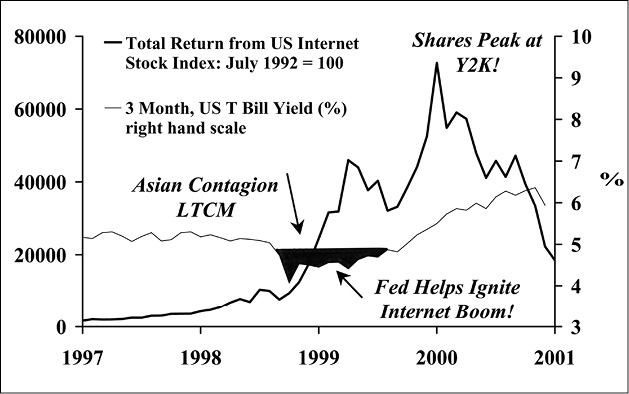
In the years afterwards, many would argue that valuations for the dotcom companies had run far ahead of their current earnings; many companies were consuming cash without a credible route to profit; the Fed and public markets had made fresh capital unusually easy to obtain; and a succession of warnings, disappointing results, and visible failures forced investors to reassess the sector.
After the drop in April, share prices continued to fall. As a result, financing became harder to come by. Companies that depended on repeated fundraising had to cut spending, sell themselves, or close shop, which further escalated the sell-off in the market.
Amazon was spared from the carnage because it had the cash from the European bonds sitting on its balance sheet. Still, Bezos finally had to act on the warnings of his accountants and CFO. He disliked managing to Wall Street’s short-term expectations, but the bust forced him to move the company towards profitability.
Amazon began to slow down on new-category rollouts. To save costs, the company shifted part of its technology infrastructure to the free operating system Linux.
In June 2000, Lehman Brothers convertible bond analyst Ravi Suria published a report about Amazon that landed like a match in dry grass. He wrote that Amazon’s credit was “extremely weak and deteriorating” and argued that the company would run out of cash within four quarters. The prediction was picked up widely by other publications. Already shaken by the wider market decline, investors sold the stock, dragging its price down by another 20% on a single day, on 23rd June 2000.
Suria had identified a vulnerability in Amazon’s business model, but his conclusion was not correct. Amazon had more liquidity than his analysis allowed for.
At the time, Amazon had nearly a billion dollars in cash and securities. It also had a negative-working-capital model that continued to work even as the stock market plummeted. Jenson, Bezos and Russ Grandinetti, Amazon’s then-Treasurer, flew around the country to reassure suppliers that Suria’s report was mistaken. Their charm offensive worked: Amazon’s suppliers did not ask for faster payment terms. As a result, Jenson’s worst fears never came to pass; customers continued to pay Amazon before Amazon had to pay its suppliers. So, customer orders continually generated cash from sales.
Even as Amazon’s stock fell from $113 in December 1999 to around $15 by the end of 2000, the number of customers increased from 14 million in 1999 to over 20 million by the end of 2000. Revenue also grew from roughly $610m in 1998 to $1.6bn in 1999 and then to $2.8bn in 2000.
Going only by the stock prices, Amazon was a doomed company, but in reality, it was becoming more valuable and recognisable amongst end consumers.
By the end of 2000, the stock market environment was dire. Many of Amazon’s dotcom equity partners — internet retailers such as Drugstore.com, Living.com and Pets.com in which Amazon had invested or partnered to expand into new categories — had failed or were heading that way. Both Living.com and Pets.com shut down in 2000.
Amazon began to re-evaluate its business model. Bezos and his team started looking at traditional retailers that needed online retailing and customer service capabilities, both of which Amazon was getting better at every quarter. It began to consider something that would seem a little ridiculous to us today: what if Amazon provided e-commerce tech to traditional, four-wall retailers?
Amazon had struggled with selecting and stocking toys. Its retail rival Toys “R” Us had struggled with moving online. Being a traditional retailer, Toys “R” Us understood seasonal demand for the toy market, had deep relationships with toy manufacturers and had the buying power to get popular toys on the shelves. Amazon had the website, customer-service operation, and fulfilment network. It made sense to partner up.
Under the August 2000 partnership, Amazon would build and host the Toys “R” Us online store, while also providing customer service, inventory management, fulfillment, and logistics services. Toys “R” Us would control product sourcing and marketing and would own the inventory in Amazon’s distribution centres.
The deal was projected to generate $32.4m in Amazon revenue in Q4 of 2000 and $75m in 2001. For context, Amazon’s total net sales in Q4 2000 were $972m, which meant the projected Q4 Toys “R” Us revenue was a modest 3.3% of total sales. But the value of the partnership extended beyond the revenue it brought. Through the deal, Amazon could put its underused fulfillment infrastructure and e-commerce capabilities to work, taking what Stone called “the first step toward making the most expensive and complicated part of Amazon’s business a platform that other companies could use.”
But where the partnership met in economics, the two companies did not see eye-to-eye in philosophy. Bezos was always clear about Amazon being an “everything” store. On the other hand, Toys “R” Us wanted to be the exclusive toy seller on Amazon. Bezos then pushed to have every toy that Toys “R” Us had to be listed on the website. Toys “R” Us refused, arguing that it would be impractical and expensive.
So, they met somewhere in the middle, as the deal was useful for both parties. Bezos, however, was never completely at peace with outsourcing his goal of limitless selection.
The platform-services model later expanded to retailers such as Borders, Circuit City, AOL and Target. AOL also brought a $100m investment in 2001 which improved Amazon’s balance sheet.
The company did layoffs around this time. In January 2001, Amazon announced that it would eliminate about 15% of its workforce. It would also close facilities including a Georgia distribution centre, a Seattle customer service centre, and a multilingual call centre in The Hague that had opened just a few months earlier.
By 2002, platform services for large retailers were responsible for about a third of Amazon’s cash flow.
The Making of the “Everything” Store
Even whilst the dotcom bust was ongoing, Amazon’s execs were focused on new initiatives to grow the business.
The biggest problem with making Amazon a store with unlimited selection was that Amazon could not possibly buy, stock, and ship everything itself. To realise Bezos’ ambition of being the “Earth’s biggest selection”, third-party sellers had to be able to use Amazon as a platform as well.
The first attempt at this was Amazon Auctions. Launched in March 1999, during an incredibly frothy time in the markets, it was Amazon’s direct challenge to eBay. Bezos was so sure it would work that he warned Scott Cook and John Doerr, both Amazon board members who also sat on eBay’s board at the time, that they might want to think about which side they wanted to be on.
But Auctions did not succeed.
Customers at Amazon came because they could find a clean product page with a predictable price. Auctions demanded a messier and more uncertain purchasing experience that eBay already owned. Amazon tried to double down by buying a company that could broadcast auctions live on its website, but it still did not solve the basic problem – customers were just not visiting the Auctions page.
The second attempt was zShops, a platform that let sellers create a fixed-price storefront on Amazon. It was closer to what Bezos wanted, but it still did not work for many of the same reasons as Auctions. Both were siloed away from the main flow of Amazon’s traffic.
In trying to look for a solution, Amazon’s executives discovered that whatever traffic the third-party sellers did get was coming from Amazon’s existing feature called Crosslinks.
Crosslinks was a feature, where third-party sellers could link their products on an Amazon page of a related product. Sometimes, it produced some ridiculous mismatches. (Once, on a product page for a children’s book titled “The Subtle Knife”, there were links that directed to sellers selling hawking switchblades and SS weaponry kits. Unsurprisingly, the person selling the children’s books stormed into the Amazon office demanding to know why there was “Nazi memorabilia” listed on his pages.) But Amazon’s product page was their greatest asset, and the reason customers visited the site.
The solution, then, was to showcase third-party listings on Amazon’s own product pages.
It was a bold move, but one that Bezos was not afraid to take.
To get a sense of why this was so remarkable, Amazon was essentially inviting competitors into its own store and placing third-party products beside its own. If customers bought from the seller, Amazon collected a small commission but lost the sale. Bezos’ principle was that if someone was able to sell the product cheaper than Amazon could, they should find out how they did it, instead of stopping them from selling.
In November 2000, just seven months after the dotcom peak in March, Amazon launched Amazon Marketplace, beginning with used books.
The launch angered almost everyone. Least happy of all were the publishers and authors who were furious that Amazon was promoting used books beside new ones, costing them royalties.
Inside Amazon, category managers now had to compete with outsiders on their own product pages. A buyer responsible for inventory worth millions could lose to a small third-party seller offering the same item at just a couple of dollars less. And if the seller delivered badly, Amazon would still have to absorb the reputational damage.
Everyone around Bezos was fuming, but that barely fazed him. What mattered more to him was that his vision of an “everything” store was coming closer to reality.
Amazon’s Flywheel
Amazon, like several other dotcom companies, had been part of the advertising excess of the era. It was famous for its ‘Sweaterman’ ads, a goofy but memorable TV campaign where groups of men dressed in sweaters sang songs about Amazon’s unlimited selection.
But by 2001, as the company faced mounting losses, Bezos started wondering if traditional TV ads were bringing in any real return. For Bezos, lower prices and a wider selection were all the advertisements Amazon really needed. But his marketing team argued that Amazon needed television to reach new customers.
To test this theory, Bezos made the team run tests in two markets, Minneapolis and Portland, to see whether the ads increased local purchase. The commercials produced some lift, but not enough to justify the spending.
As a result, Bezos cancelled all television advertising. But more was in store for the marketing team. Over the next few years, the budget allocated for marketing was spread across other functions. Central marketing was shut down, and its function was split across the email marketing and discovery teams. In the words of Diane Lye, who helped run the ad tests, “There can be only one head of marketing at Amazon, and his name is Jeff.”
Part of the marketing budget would be funnelled into what Bezos called the “flywheel”: lower prices and a wider selection would bring more customers; more customers would attract more third-party sellers; more sellers would expand the selection, driving volume; more volume meant that Amazon would become more efficient by absorbing more of its fixed costs running the fulfilment centres and the servers; a more efficient Amazon could lower the prices even further. The cycle would continue.
Investing the marketing money in any part of this loop made more sense to Bezos than buying a spot on television. It would also be spent on another one of Bezos’ unconventional ideas: permanent free shipping.
During the 2000 and 2001 holidays, Amazon offered free shipping to customers who ordered more than $100 worth of items. It was expensive, and in the middle of the bust, it looked almost perverse, but it increased sales.
The promotion worked in two important ways.
First, it removed one of the most annoying barriers to online shopping. Many customers would find a good price on Amazon, only to abandon their cart at the checkout page when shipping charges were included.
Second, it encouraged shoppers to add items from different categories in the cart. Bezos, always looking for ways to associate Amazon with the “Everything Store”, realized that customers who came for just a book would end up adding a DVD or a kitchen item just to qualify for the free shipping.
To turn this into a permanent feature and not just a holiday bonus, Bezos sought advice from his CFO. The debt-averse Jenson was understandably repulsed by this idea. From his perspective, not only was it expensive, but it was also wasteful. Amazon would be giving away free shipping to customers who would have ordered more than $100 worth of goods anyway.
Much to Jenson’s dismay, one of his deputies suggested an idea that pleased Bezos. Airlines had long separated business travellers from leisure travellers by giving cheaper fares to customers willing to stay over a Saturday night. Perhaps Amazon could do something similar? What if it offered free shipping to those customers willing to wait a few extra days?
Customers who cared more about saving money than receiving the order immediately could choose the slower, free option. It would also reduce the cost of shipping as Amazon could pack those slower orders into trucks when there was extra room.
So, in January 2002, Amazon introduced Free Super Saver Shipping for orders above $99. Within months, the threshold dropped to $49 and then to $25. Amazon issued a press release describing the offer as indefinite and available 365 days a year. This was to become the precursor to Amazon Prime, which launched three years later with unlimited two-day shipping for an annual fee.
By the end of Q4 2001, Amazon announced that Marketplace, which had started with used books in November 2000, had grown from roughly 1% of total US orders to 15%. Compared to the previous year, annualised inventory turns had improved from 18 to 25, and operating cashflow improved 41% to $349m.
Bezos was always keen on spending on the shopping experience. He believed that such investment would create repeat customers, and that this was more important than chasing short-term profit. His methods were not always popular among the people around him.
Bezos and his Bold Decisions
According to Stone, “bold” was one of Bezos’ most frequently used words. It appeared repeatedly in Amazon’s first shareholder letter, where Bezos and former CFO Covey wrote that the company would make “bold rather than timid” investment decisions when they believed those investments could create market leadership. That word also describes many of his decisions during this period.
Bezos repeatedly made choices that appeared irrational from the outside but were consistent with his long-term vision of Amazon. He expanded aggressively into categories beyond books when critics questioned whether Amazon could manage its existing business. He built more fulfillment and service centres than the company could afford. He refused to abandon his idea for a third-party marketplace after failing twice. He allowed outside sellers to cannibalise his own retail sales and offered free shipping at a time when the company was struggling to keep its spending down.
This conviction, as admirable as it was, made him difficult to understand, even for senior execs who had joined early and watched Amazon ride the dotcom wave.
By 2002 and 2003, most of the senior leadership were done. Stone says the company reached “incredible levels of attrition” during these years. The exits included people like SVP of US Retail David Risher, VP of Engineering Joel Spiegel, SVP of Worldwide Services, Sales and Business Development Mark Britto, VP and General Manager Harrison Miller, VP Chris Payne and CFO Warren Jenson, people who had built the company through some chaotic years.
Some executives’ stock had vested, and they were ready to leave. Some felt Bezos did not listen to them. Some were simply exhausted after years of relentless expansion and pressure to perform. But to many, it looked like the Amazon story had already reached its climax.
Net sales for the quarter ending in December 2001 reached $1.12b, Amazon’s first billion-dollar quarter. Amazon had survived the dotcom crash and, contrary to what Barron’s had predicted, Bezos had successfully laid the foundation for Amazon’s next decade of growth.
Sources
Primary source for this case was Brad Stone’s The Everything Store: Jeff Bezos and the Age of Amazon (2013)
Lynda M. Applegate, “Amazon: The Brink of Bankruptcy”, Harvard Business School case 9-809-014, revised 16 July 2019.
https://en.wikipedia.org/wiki/Dot-com_commercials_during_Super_Bowl_XXXIV
https://www.cnet.com/tech/mobile/yahoo-ipo-closes-at-33-after-43-peak/
https://web.archive.org/web/20000229230052/http://www.theglobe.com/
https://www.cbsnews.com/news/internet-ipo-theglobecom-soars/
https://www.latimes.com/archives/la-xpm-1998-nov-14-fi-42595-story.html
https://nypost.com/2000/06/27/analyst-finally-tells-the-truth-about-dot-coms/
https://www.wired.com/2000/06/analysts-send-amazon-down-river/