Case
The Leadership Corridor: How James Kilts Built Leaders at Gillette
James Kilts is best known for the Gillette turnaround — the four years between 2001 and 2005 in which he took a company that had missed its own earnings estimates for fifteen consecutive quarters and turned it into what Warren Buffett called a “dream deal” when Procter & Gamble (P&G) acquired it. But there is a second thing Kilts did at Gillette that is arguably more remarkable: he built a deep bench of executive talent in a company that had almost none when he arrived.
After the P&G merger, his thirteen direct reports on the Gillette Operating Committee moved into senior roles across corporate America. One became CFO of Avon. Another was given responsibility for P&G's entire oral care business. A third became president of sales for P&G North America, overseeing more than $34 billion in annual revenue.
The same pattern had followed Kilts previously at Nabisco, where his two business unit heads — Rick Lenny and Doug Conant — went on to become CEOs of Hershey and Campbell Soup respectively. And before Nabisco, at Kraft, the alumni list was even longer: the CEOs of Mattel, Sears, Quaker Oats, Young & Rubicam, and Marks & Spencer all came out of the same system.
This track record is very unusual because most large companies struggle to produce even one capable successor. Many see their senior ranks consumed by internal conflict with executives vying to capitalise on the power vacuum rather than building capability beneath them. Others, like Howard Schultz’s Starbucks, discover that the entire organisation falters the moment a founding CEO tries to step back. The most common outcome in corporate America is a succession crisis, not a deep bench.
How then, did Kilts keep producing competent leaders, in company after company?
The answer traces back to a management development framework called the Leadership Corridor, built at Kraft in the 1980s by CEO Mike Miles and his head of human resources, John Tucker.
Most companies treat leadership development as something that happens in a classroom. These commonly include (but aren’t limited to) off-site programmes, case studies, and topical courses that run outside of the day-to-day work of the organisation.
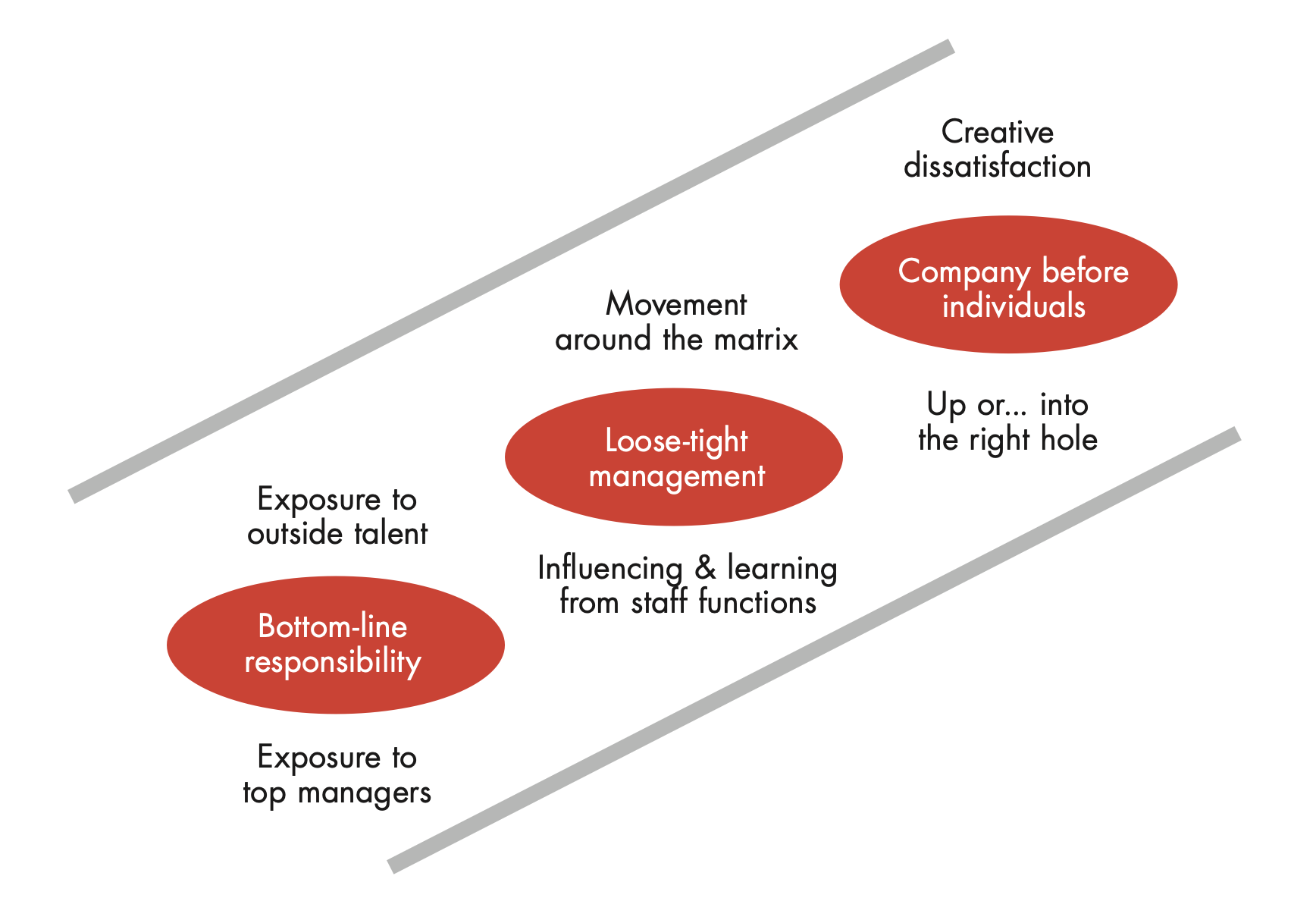
The Kraft system was different because development took place on the job, and for the job. As managers advanced, they moved through a series of experiences organised around three stages, each tied to a core principle of how Kraft actually ran its business. These stages were:
Assuming bottom-line responsibility — the dominant development principle in a Kraft’s manager’s early years was responsibility for the bottom line. This underscored Kraft’s belief that cost reduction was not a one-off, reactive program, but an ongoing process for freeing-up cash to invest in brand marketing. (Kilts internalised this belief; he brought it to Gillette with him). Managers were thus expected to deeply understand the supply-side of the business: often with the expectation that they should go down to the farms to understand the inputs to their products, or walk the factory floor to eke out productivity enhancements alongside production specialists. During this stage, early-career managers were exposed to good outside talent, and to top leaders within the company (Kraft attempted to limit the number of management layers, so that junior managers would have access to the top).
Practicing loose-tight management — once young managers had develope ...
The rest of this article is for members only.