

Some of you will already know that over the past six weeks or so, we’ve had five workshops from Roger Williams, teaching us Eliyahu Goldratt’s Thinking Tools. What made these workshops particularly practical is that we were using several tools that Roger had vibe-coded. These workshops were provided for free, and more than 70 members signed up, although each session had way fewer attendees than that. Eventually, we settled into a core, cosy group who were really committed to applying the tools.
(I’ve also heard from various members who didn’t attend any of the sessions but binge-watched all the recordings — these folks have either started putting these tools into practice in their own lives / on their career problems or have begun reading about Goldratt’s Theory of Constraints. The workshops were very impactful! Yay!)
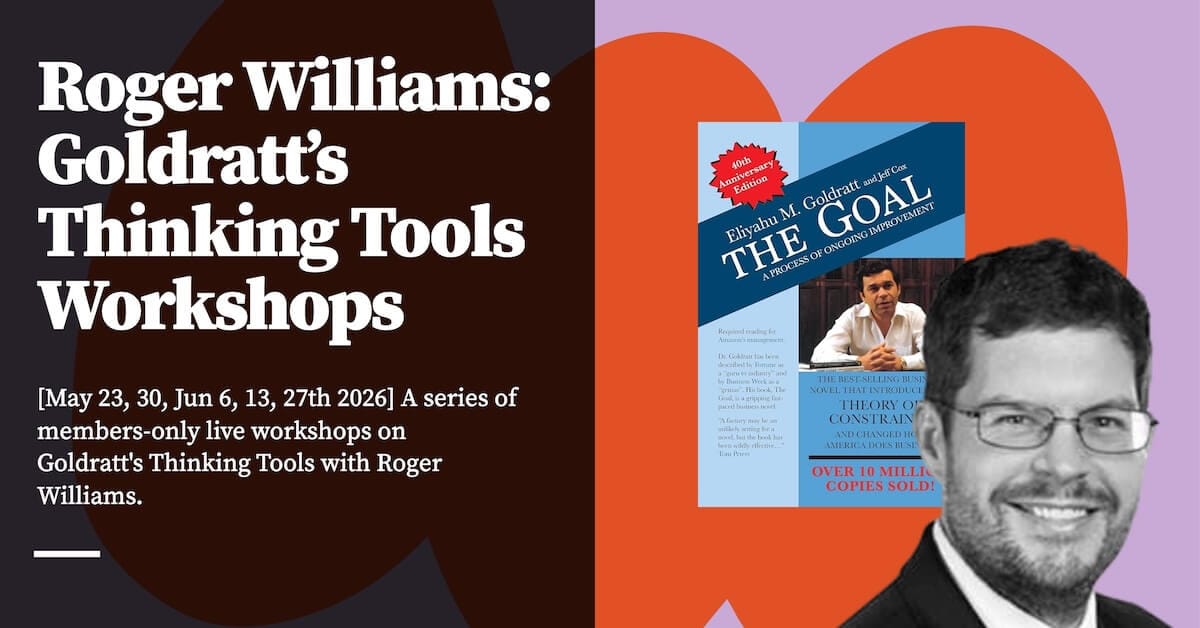
When I offered to host these workshops — and to let Commoncog’s business be the subject of Roger’s demonstration — I knew very little about the Theory of Constraints or the Thinking Tools. I tend to fall into rabbit holes, so I need to be very disciplined about the ideas I look into. (Roger confirmed, early in this series, that ToC was a very deep rabbit hole indeed!) That, plus the fact that the last time I explored a manufacturing-related idea — the one that led to the Data Driven series — it took me on a three-year journey researching and testing a group of ideas. These were the same ideas that led to the creation of lean manufacturing and the Toyota production system, so they were quite consequential. I suspected that ToC was of the same flavour.
So it was with some trepidation that I embarked on this journey, having done nearly zero reading on the topic. In fact, I was perfectly happy to defer to Roger and to other members who had gone down the ToC rabbit hole. To a great degree, I treated this like a business adventure.
Roger was a particularly effective teacher. He’d used the thinking tools a lot in his professional life to be genuinely believable in its application. And he had coded up easy-to-use web tools — made possible by Claude Code — which made it much easier to follow along since the web tools themselves were so straightforward to use.
Over the course of the series, I began to realise that the thinking tools were pretty much ‘common sense’, ruthlessly applied. If you think about the five tools that we covered in this series, each tool represents a style of thinking that is likely something you’ve done before. And in fact, it describes the kind of thinking you’d expect to do if the circumstances around you were good, you were emotionally stable, and you could look at your situation objectively, with no frustration.
When you frame it like this, the thinking tools simply allow you to repeatably and reliably do the same kind of thinking, even when you feel frustrated or when you are emotionally compromised. That, I think, is the true value of these tools.
It’s no wonder that the vast majority of members — myself included! — testing this are doing so in career or personal life situations where they’ve (we’ve) been frustrated for a while.
Let’s go through the five tools quickly, just to prove to you that you've actually used them all before:
- The Current Reality Tree helps you see the present moment clearly and forces you to map out the state of affairs leading to the negative effects you're experiencing. You’ve probably done the same thing before by taking a break, travelling to a faraway place, and taking stock of your situation.
- The Evaporating Cloud helps you uncover the assumptions in your thinking that are getting you stuck. You’ve likely experienced this if you’ve ever worked with a coach, or mentor, or manager who is somewhat removed from your problem. They can very quickly debunk one of your assumptions, and suddenly you are no longer stuck. If you've experienced this before, you likely know the feeling of creating the Evaporating Cloud effectively — except now you’re just doing it to yourself.
- The Future Reality Tree is essentially a thinking exercise that asks you to imagine how to increase the odds of success for your plan, and how to head off the predictable negative side effects. You are then expected to modify your plan before you start executing.
- The Prerequisite Tree is basically what is known as a ‘backwards plan’ — you start with the end in mind, and then you work backwards until you list all the tasks that you need to do in order to get to that endpoint. (This is what I — and many others — tend to do when doing product launches or events).
- Finally, the Transition Tree is about surfacing the parts of your plan where you don’t actually know how to get to your goal. It may be used in lieu of the Prerequisite Tree.
Taking a look at these five tools, you’ll quickly realise that you’ve probably used all of them before, in various contexts. We just tend to forget that what made us effective in one area (work!) can often be applied to another part of our lives (personal problems!) During the final workshop, a member said that he hadn't realised you could apply the tools to your personal life, and thanked Roger for showing that it was possible. Since the workshops series started, the member had started doing just that, using Claude as an interrogator, to good success.
Something else came up in the final session that I found interesting — a discussion about when to use these tools. I’d wondered whether usage of the PRT or the TT, for instance, might lead to analysis paralysis, particularly if you’re the type who tends to overthink rather than act. Roger and several other participants agreed, but pointed out that these tools are really meant for situations where you're not thinking enough (or thinking correctly) to solve the problem at hand. (Roger: “doing without thinking is also a failure mode!”)
A participant then added an additional angle: you can use these tools to identify what information you still need to generate, and then work out the activities required to successfully generate it!
The final piece of reflection I have is on the accessibility of these ideas. When I first announced the series, it took me several hours to figure out the right angle for explaining why you might be interested in them. Because let’s face it: both the name and the idea behind it are quite off-putting. Why do we need a theory of constraints? That sounds too academic! And then when you actually look at it, the theory itself is super common sense — obviously, when you’re trying to improve a system, you want to focus on the bottleneck, because everything else doesn't have nearly as large an impact.
In the end, I had to tell the story of an Olympic swimmer who applied these tools to her life and subsequently broke the Olympic record as part of the 4x200m relay team, despite being one of the shortest swimmers in the entire category. The fact that I had to use that story is revealing, I think. These tools are very powerful, but they get overlooked because they seem ridiculous.

Hopefully, if you’re reading this piece, you now know that this is not true. And you know that you have a series of workshops that will teach you to apply them to whatever problem you’re facing — in your business, in your life, or your career — with web-based tools that, really, anyone can use.
Special thanks to Roger, who taught us, and to everyone who participated. I’ll see you in the members forums.
Originally published , last updated .
Ideas and cases to accelerate business expertise
Commoncog is a publication dedicated to the serious study of business.
We are businesspeople serving other businesspeople. We develop methods to build business expertise, faster.
Your time is valuable. We publish only what we think is useful, tested, and good.
Sign up to receive our latest writing: