This was the text of the Commoncog newsletter, sent 25th June 2026. This week’s Commoncog case is ... well free, though you might not want to read it. We’ve also got two members-only case reactions.
Heh, boy do I have a predicament this week.
I was travelling last week, so I couldn’t publish. But I’d gotten a case ready, commissioned weeks in advance, and was going to publish that on Monday.
So you might have noticed that this is a Thursday. What happened?
Well, two things happened. First, I fell sick upon return. Travelling with a baby whilst sleep deprived can do this to you! (That’s two times I’ve fallen sick on this trip, which, sigh, life).
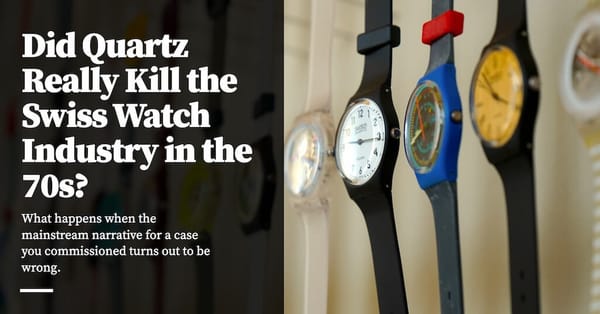
But the second thing is more interesting. The case I had commissioned was about Swatch, and about how Swatch saved the entire Swiss watch industry from the quartz crisis. The reason this case is useful is because sensemaking: in How Experts Sensemake I explained that one implication of the Data-Frame Theory is that you need to collect fragments of cases to help improve your frame construction abilities. If you want to make sense of AI, you’ll want to collect stories of businesses and people winning (or losing) in the face of technological disruption.
So you can see why it might be useful to figure out how the Swiss watch industry survived quartz — a technological disruption if there ever was one.
The case I commissioned hewed fairly closely to the mainstream narrative of the quartz crisis. And to be fair to my writer, this narrative was the same narrative that the Swatch group pushed for much of their history. The narrative goes like this:
- The Swiss watch industry was dominant.
- Quartz was around for a bit, but Seiko perfected it, and drove the cost down in the 70s. This is, to be clear, a technological disruption in every sense of the word. Quartz is both way more accurate (30x, if you compare to a COSC-certified chronometer), and much, much cheaper than mechanicals (in some cases 100x, especially if you compare at the end of the 70s).
- Buoyed by Japanese manufacturers, quartz watches and movements overtook mechanical watches; attacking in every market around the world over the course of 1975 to around 1985. They decimated the Swiss watchmakers.
- Fed up with supporting the failing Swiss watch holding companies, Swiss banks brought in Nicolas Hayek, a Lebanese born Swiss business consultant who specialised in operational efficiency. To be clear, the ‘Swiss watch holding companies’ at this point meant two parties: ASUAG, which primarily owned movement manufacturers (that supplied most of the Swiss watch industry) and some lousier Swiss watch brands, and SSIH, which owned Omega, Tissot and Lemania.
- Hayek studied both companies and proposed a merger, along with a rationalisation of the (really messed up) production systems. In addition to that, Hayek suggests going on the offensive: launching a cheap quartz watch at the bottom of the market, to go toe to toe with the Japanese.
- The banks loved the first idea. They put Hayek in charge of the merger and rationalisation. They hated the second idea. So they offer Hayek a large block of shares if he wanted to execute the cheap quartz thing. Hayek gathered a pool of rich Swiss individuals and together they bought control of the company.
- And they launched the Swatch. The Swatch was sexy. The Swatch was cool. The Swatch exploded into fashion circles everywhere and generated cash that Hayek could put to good use revitalising the older, grander Swiss watch brands that they owned. They soon began to acquire other failing watch brands.
- Around the same time, a gentleman and former Omega exec by the name of Jean-Claude Biver was proving out a new positioning strategy. He had bought over a storied watch brand called Blancpain and he started selling it on the basis of luxury, history, and Swiss craftsmanship. Blancpain was a success. More importantly, Blancpain proved that this luxury repositioning had legs. Eventually, Hayek bought it and folded it into the group — and he could see that Biver was the real asset here. He put Biver in charge of Omega and tasked him to revitalise the dying brand. Biver did so. He switched James Bond over from Rolex to Omega. He brought in the co-axial escapement. (If you’re not a watch nerd, just know that this is still one of Omega’s primary differentiators today). Biver turned Omega around within a few years.
- The two things: sexy quartz watches at the low end and increasingly premium, high-margin mechanical watches at the middle and high end, turned the Swatch group’s fortunes around. And with those increased fortunes Hayek could acquire more and more watch manufacturers and watch brands, paving the way for the Swiss watch industry to recover. The turnaround was complete.
So this is the mainstream narrative. I had published the case on the Commoncog Case Library and then was about to record a case reaction. But because I was sick, I procrastinated and started reading A Business History of the Swatch Group by Pierre-Yves Donzé whilst convalescing.
And then I realised this entire narrative was wrong.
It was wrong in two big ways (and many small ones):
- The Japanese manufacturers were kicking the Swiss watchmakers’s asses before they got quartz to work for them. So they were killing the Swiss with mechanical watches, even before quartz came around. How? Well, it becomes easier to understand if you reframed the crisis as that of production technology outcompetition, not product disruption. Quartz merely accelerated the problems with Swiss manufacturing!
- The Swatch did not generate most of the cash to enable Hayek to go on his acquisition spree. In reality it was Biver’s strategy with Blancpain, which Hayek and all the other watchmakers started copying, coupled with Hayek’s production genius, that created the fat margins that enabled Swatch group's growth without further infusions of external capital. (In fact in the early years they spent much of this cash paying down their debt load). Now I have two notes here. First, Swatch was important to Hayek and the group for one other reason (marketing). I’ll get into that in the case itself. But secondly, this observation is actually more interesting, because it mirrors what was happening throughout (what we now know as) the ‘luxury’ industry: rationalised production of high-craft products with effective cost control, sold with luxury positioning at aspirational price points to the upper middle class. This idea really only emerged in the 70s and 80s. To put this differently, the strategy was being discovered by Biver, yes, but also by Bernard Arnault in LVMH and then later Johann Rupert at Richemont. You can actually reframe this entire case as a story of the emergence of global luxury as a business, not a story of technological disruption.
What is startling to me about this argument is that it is fairly new. Donzé is the watch industry’s foremost living historian, and he first made this argument in a paper in 2009, in French. (Business History of the Swatch Group is an English translation of a latter book, also originally in French; the English edition was published in 2014). A contemporary of his, Johann Boillat, made a bunch of related arguments that were published only in 2012. (I’ve elided them in this newsletter for the sake of brevity, but will be including them in the case rewrite).
But anyway: blah! I couldn’t publish!
So here’s what I’m going to do: I’m publishing the original case (which carries the flawed mainstream narrative) on Google Docs here:
How Swatch Saved the Swiss Watch Industry from the Quartz Crisis
Which you may read, if you so desire. I’ll rework and republish it — along with a case reaction — next week.
Bear in mind why we are reading this case, by the way. We are not reading this for the sake of history (although that’s good to do!) We are reading this to figure out how Hayek and Biver and the rest made sense of the facts they saw during the crisis. That way we can use this fragment in our own sensemaking, in order to construct new frames to deal with AI.
If you’re new to Commoncog and don’t understand how that works, please read How Experts Sensemake.
Members-Only Content
In my last newsletter I published Sensemaking as the Heart of Expertise. The essay describes how helping novices to see like experts will help accelerate expertise. At the end of it I told you about a members-only experiment you could participate in: instead of explaining the training method to you, you could experience one intantiation of it for yourself.
I’d prepared three cases in the Business Expansion concept sequence:
- The Amazing Growth and Predictable Death of Ample Hills Creamery
- A 92 Year Old Singaporean Distributor Closes Shop Forever
- How Clinique was Created, and How It Nearly Killed Estée Lauder
You were supposed to read each case, record your sensemaking using the voice memo app on your phone, and then listen to my case reaction, embedded at the bottom of the case. Then you were supposed to compare your sensemaking to mine, again using voice memo. Rinse and repeat for each case.
This week, I’ve added two new case reactions to the Business Expansion concept sequence:
These cases are meant to be consumed after the first three, and were chosen because the two cases together tell the story of an Asian tycoon’s arc of growth — someone who started out not very good at business expansion, highly risk averse, and eventually built a global hotel empire ... through acquisition.
Note: members may leave reactions to these cases in the forum, in the comments section at the bottom of each case ... or to the overall sensemaking training experiment here.
Originally published , last updated .
Ideas and cases to accelerate business expertise
Commoncog is a publication dedicated to the serious study of business.
We are businesspeople serving other businesspeople. We develop methods to build business expertise, faster.
Your time is valuable. We publish only what we think is useful, tested, and good.
Sign up to receive our latest writing: