

A few weeks ago I wrapped up a short series on sensemaking. The explicit goal of that series was to give you better methods to make sense of a potentially disruptive new technology — which at the time of publication (and probably for a few more years yet) will be about AI. But the series was about sensemaking in general, and the ideas we explored together are applicable whenever you have to make sense of new developments in investing or business. This means that the methods may be adapted to make sense of politics, or social change, or — god forbid — war.
I had an ulterior motive to writing that series, though. One of the nice things about the serial nature of Commoncog is that I may introduce a new concept as a foundation, and then build on that concept in the subsequent weeks or months. So I’ll be honest with you: I wrote that series because I needed to introduce the Data-Frame Theory of Sensemaking.
Why? Well, you actually probably already know why. In my essay on the Data-Frame theory, I left a throwaway paragraph:
I don’t want to put too fine a point on this, because this is important. The observation that experts construct different frames compared to novices is actually profound. Frame construction is the bit of tacit knowledge that matters. It is the bit that accelerated expertise training programs attempt to train for. If that isn’t enough, frame construction is directly linked to insight generation. Insight generation is really important! If you study cases of business strategy, every winning strategy boils down to a few small insights that frame the problem advantageously — which the rest of the strategy is then built around. Richard Rumelt calls this the ‘kernel’. Roger Martin calls this answering the twin questions of “where to play” and “how to win”. The point is: if you can frame the problem you’re facing properly, you have half the problem solved.
You might’ve read that and gone ‘huh’. But it gets better.
Earlier this year, I wrote Our First Accelerated Expertise Course, shortly after running Cohort Two of Speedrunning the Idea Maze. In that piece, I said that I’d finally figured out how to apply Cognitive Transformation Theory — one of two theories of accelerated expertise, and one that I never really understood how to use. I said that I’d explain what it is and how it works in a future blog post. Well, here we are.
It turns out that in order to understand Cognitive Transformation Theory, you need to first understand the Data-Frame Theory. Since we have both of those things now, we can tie things together. We can also — finally — talk about how to use this in our lives.
The Core Idea
The core idea is ridiculously simple.
- Experts can see things that novices can’t.
- If you can teach novices to see the domain like the experts, you will accelerate expertise.
That’s it. That’s the entire shebang in two sentences.
But ok, this isn’t actually useful. We need more detail in order to put this idea to practice. I’m going to assume you’ve read the essay on the Data-Frame theory, because I’m going to start using theory-specific terminology now:
- You make sense of a situation by constructing a frame in your head. That frame determines what you notice and what you ignore in a situation. Imagine a novice rock climber and an expert rock climber looking at the same rock face. The expert would see handholds and other affordances that they may use to scale the wall that the novice would be completely blind to. The expert will also know what rock climbing techniques may be used in concert with which affordance; the novice has no such library of techniques in their head, and wouldn’t even know where to begin.
- In other words, data does not exist, ‘on its own’, in the world. Rather, the designation of ‘data’ is something you assign during the process of framing. Data only makes sense within context of a frame. If you don’t have a frame, you won’t notice things — much less the right things.
- Experts construct better frames than novices.
- Teaching novices to see like experts means helping them construct better frames. It also unlocks their ability to do better trial and error. If a novice rock climber can suddenly see a rock face the same way an expert can, they will know all the techniques they don’t yet have, and work to acquire those techniques on their own. They may not even need a coach to make good progress.
- It gets better: experts are able to make sense of novel situations — situations that nobody has seen before — by constructing new frames, on the fly, from fragments of cases (or fragments of causal models) that they have in their head. This explains adaptive expertise: that is, how experts can outperform novices in domains where things keep changing and where there is constant novelty (e.g. business, investing, medicine).
- Therefore the puzzle of expertise acceleration may be reduced down to a single question: “how may we get novices to become better at frame construction?”
You answer that question, and you’ll have gotten closer to expertise acceleration.
“Wait,” you say, “I don’t buy this. What about deliberate practice? What about maths? You don’t get better at maths by ‘getting better at frame construction’. You get better at maths by grinding at math problem sets! This is the known best way to get better at maths!”
I hear you. We’ll tackle all of these concerns in future essays. (If you’re a Commoncog member, you might already know the answer, since you have access to our private Q&A with former professional mathematician David Bessis).
But for now, I want to show you two things.
First, I want to point out that this central focus on ‘sensemaking’ in expertise has actually been hiding in plain sight all this while.
Long term Commoncog readers would recognise the following diagram, which shows us the Recognition Primed Decision Making (RPD) model, which we’ve talked about here and here.
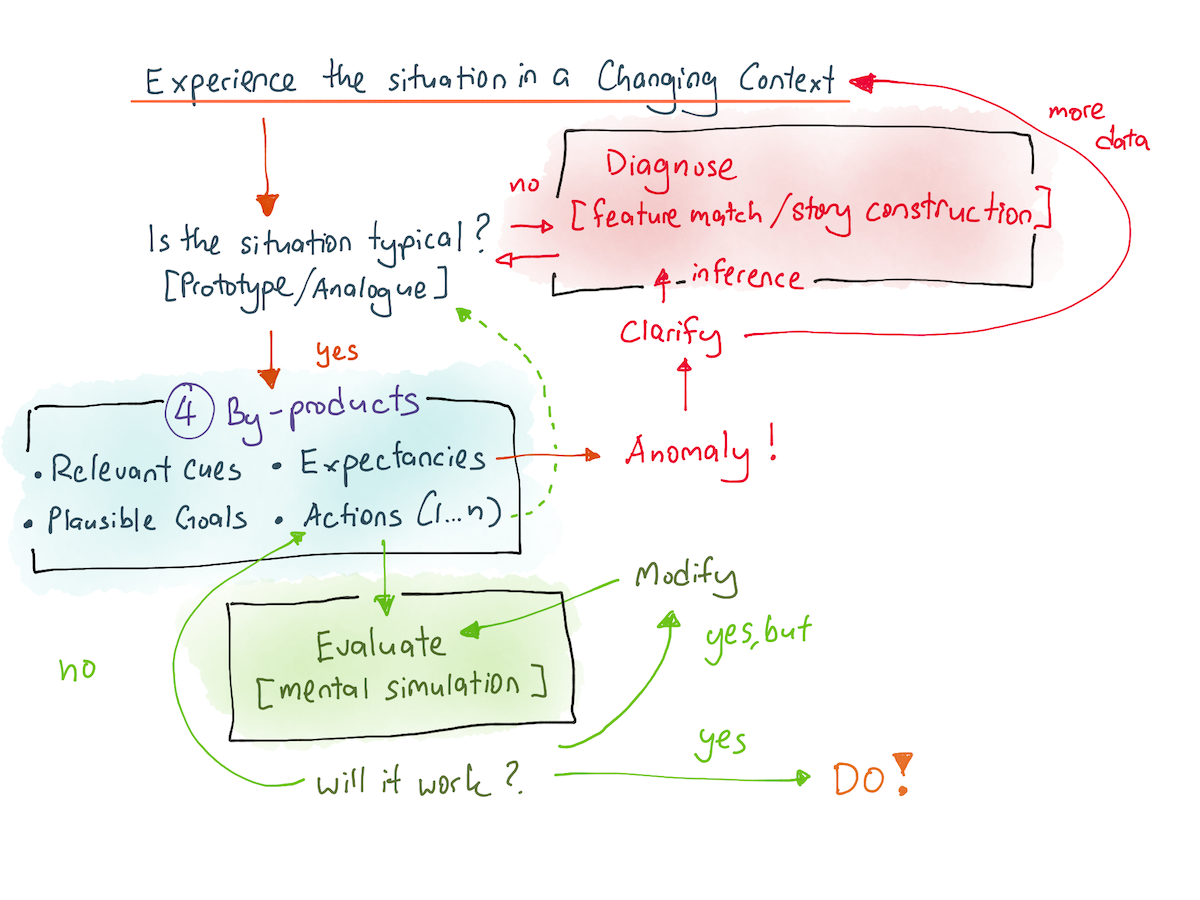
RPD is powerful because it tells us what expert intuition actually is, and it allows you to pick the brains of the experts around you. Here’s a quick recap. When an expert is faced with a typical situation in their domain, they pattern match using the same part of their brain that does facial recognition (implicit memory), and they automatically generate four by-products of recognition:
- They notice and keep track of relevant cues in the situation.
- They generate a list of expectancies.
- They generate a list of plausible goals.
- They generate an action script. (They also simulate that action script quickly, just to see if it’s plausible and might work; this is the bit at the bottom of the diagram).
However, if at any point their expectancies are violated, or if they cannot immediately recognise the situation they are facing, they will fall back into … sensemaking. You could say that the red bit in the diagram is basically explained by the Data-Frame Theory of Sensemaking.
(With one small caveat: Gary Klein has never explicitly come out to say this).
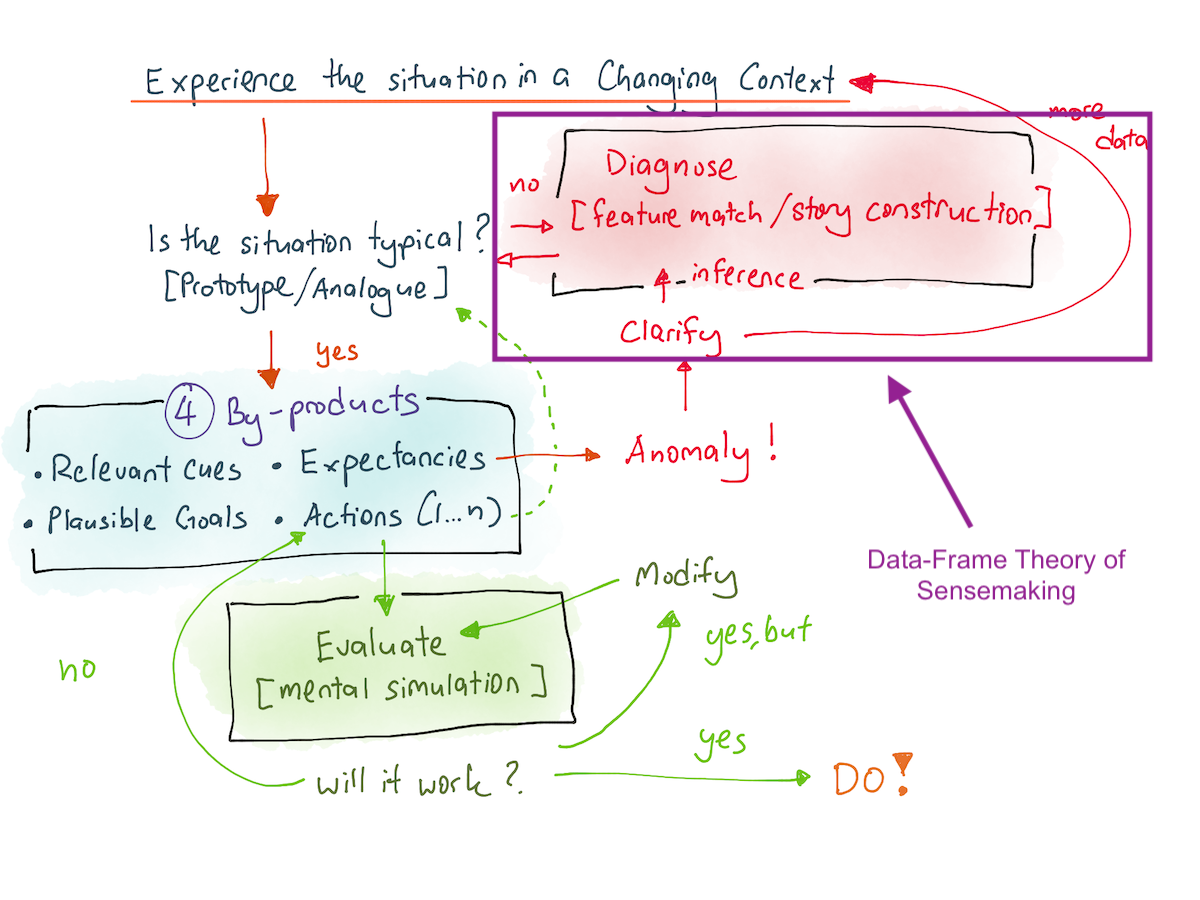
Training that red bit of the RPD model is just as important as training overall pattern matching. Yes, you do want to get good enough to do recognition-primed decision making. (This is what you may call “tacit skill”, or “unconscious competence”, or “expert intuition”, and it’s why experts aren’t easily able to explain how they do what they do). But it’s also important to train frame construction. And in fact getting better at frame construction helps with building expert intuition.
Jared Peterson, who currently works for Gary Klein, has a piece where he describes the formation of Naturalistic Decision Making (NDM). NDM, of course, is the field of applied psychology that is most closely associated with tacit knowledge extraction and accelerated expertise. It was founded in part through the efforts of Klein and his colleagues. Peterson writes:
(…) Around the same time, other researchers in similarly high stake domains were discovering the same thing. In 1989, these researchers gathered in Dayton, Ohio not realizing what they were staring. At that first conference, they hadn’t yet conceptualized themselves as a distinct field of study, and they certainly didn’t have a name. But at that conference a few themes emerged:
- They were interested in complex, real-world (naturalistic) environments characterized by time pressure, uncertainty, ill-defined goals, high personal stakes, and other intricacies. Fields like firefighting, law enforcement, tactical decision-making, medicine, aerospace, etc.
- They were interested in experienced experts who consistently performed well despite complexity. Not novices, and certainly not undergrads.
- How people made sense of situations often mattered more than deliberating over predefined options (emphasis added).
The third theme stands out a little. While the first two themes identify similarities in what and who they studied, the third was more an insight that many of them had independently discovered, and which Klein had started to pull the string on in that initial practice interview with the fire commander.
And so it turns out the entire field of Naturalistic Decision Making has been working to understand how experts make sense of situations and how to train people to do the same for the past 30 years. In other words, frame construction is how you get accelerated expertise. This is what I mean when I say that frame construction is actually the bit of tacit knowledge that matters.
Arguably, this is the bit that will remain important as AI invades our workplaces.
But ok, enough preamble. I want you to experience this for yourself.
An Experiment for Commoncog Members
The quickest way to get you to understand how this training approach might work is to demonstrate it to you.
I want you to do the following exercise. Trust me, this will not take very long, and will be quite enjoyable to do, assuming that you like daydreaming.
(Yes, daydreaming. You know how it feels like when you’re on a long car ride and you’re staring out the window and just letting your thoughts wander a little? Yeah, this should feel like that. That is actually what it feels like when you’re learning to sensemake better.)
A few weeks ago I published a bunch of new cases around the concept of ‘Business Expansion’, in preparation for this exercise. The idea itself is quite easy to understand, and very familiar to anyone who has had even a little business experience: if you’ve been doing business for a bit, you might have already noticed that plenty of businesses die from growth. The simplicity of this concept makes it ideal for our little experiment. For instance, good business expansion is an aspect of business skill that is quite easy to spot — experienced businesspeople are cautious when growing their businesses, for they know that growth can kill them. But they’re also not too cautious, for they know no growth in a dynamic industry will also kill them. Acquiring this calibration seems quite valuable! As a result, I’ve put together a sequence of cases demonstrating both successes and failures in business expansion.
I want you to do the following.
- Read the first three cases of the Business Expansion concept sequence, in order: The Amazing Growth and Predictable Death of Ample Hills Creamery, A 92 Year Old Singaporean Distributor Closes Shop Forever, and How Clinique was Created, and How It Nearly Killed Estée Lauder. These are the three cases that I’ve prepped for this experiment.
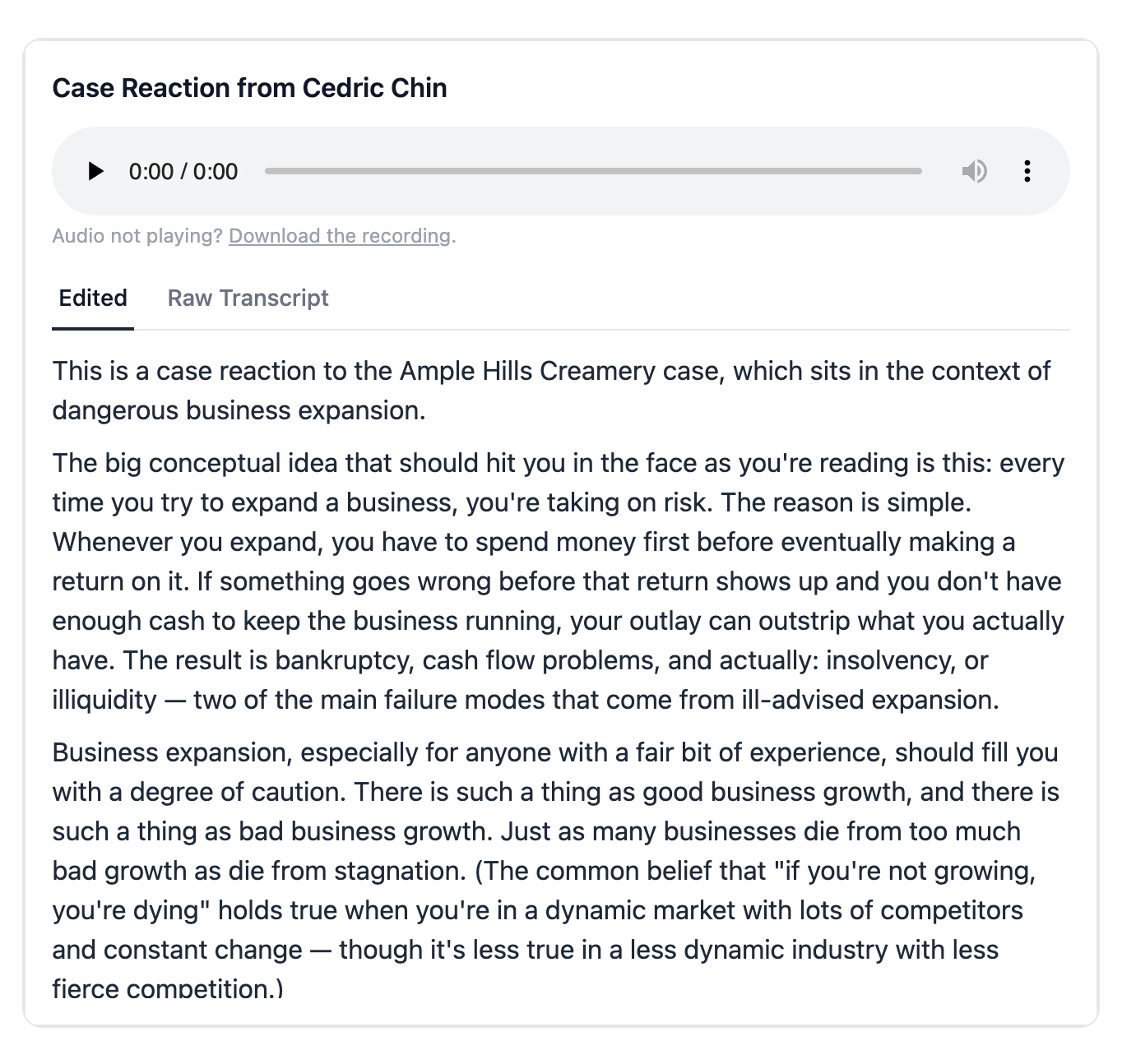
- At the end of each case, pull out your phone and record a voice memo. This can be however long you like, though I recommend a minimum of two minutes of talking. React to the case: talk about what jumps out at you, what you notice about business expansion (or, really, about any other concept that the case embodies) and any other reactions you might have to the details of the case.
- After you’re done recording your voice memo, listen to my sensemaking at the bottom of the case. (You may also read an edited transcript of my recording). For obvious reasons, do not listen/read to my reaction before you do yours!
- Finally, record a short voice note talking about what I noticed that you didn’t, and what you noticed that I didn’t, and whether this might affect what you notice about future cases.
- Rinse and repeat for each of the three cases linked to above.
Here’s what the case reaction looks like at the bottom of each case:
There are two more things you may do:
- First, if you’d like, you may compare and contrast between the three cases as you progress. Call out surprising similarities and surprising dissimilarities between the cases. Do this in your voice memos.
- Second, record a separate voice memo reflecting on cases of good or bad business expansion that you’ve observed in your own life.
That’s it. That’s the entire experiment!
Here is what this accomplishes, and what you should — fingers-crossed — experience:
- First, you’re pre-recording your sensemaking and then comparing your sensemaking to mine. Now, ideally you’d want to compare your sensemaking to an expert — and I’m not really an expert at business expansion (compared to some folks). However, I’m likely to notice things you won’t because I’ve spent many more hours editing and reflecting on this case, by dint of my role as publisher. (One obvious, follow-up idea is that we can get ahold of proper experts to do this, going forward — especially if we can make this easy for you to do.)
- Second, notice that you’re reflecting on the differences between your sensemaking and my sensemaking. This is how you improve. One of the more interesting things about Cognitive Transformation Theory is that it places much emphasis on having students make sense of their own feedback. And, more importantly, the feedback should not be clean. This makes sense. We are trying to accelerate your expertise in a messy, dynamic domain. Much of your experience learning from real life requires you to make sense of noisy feedback as the outcome of trial and error. This is one of the more insidious impacts of formal education: clear feedback — like the kind you get from, say, maths problem sets — degrades your ability to learn from life. So we want to train your ability to make sense of messy feedback, but we don’t want it to be too messy, lest you become unmoored.
- If this works, you should begin to notice that your sensemaking will change: you are able to see more things from stories of business expansion than you would before. Also, fragments of these cases should pop, unbidden, into your head when you’re in a business expansion situation, because this is how human brains work. (Specifically, we are using the human propensity to remember stories to our advantage here).
- Finally, reflecting on real examples of good and bad business expansion — taken from your own life — will consolidate your ability to make sense of your own experiences. In a way, we are training you to get better at learning from trial and error … without the costs of actual trial and error.
The more pedagogically inclined folks here might already notice that this is actually a generalisable training method. You may apply this style of teaching to computer programming, to developing taste in movies, to leadership skills, to business valuation, to M&A, and so on.
But I want you to give this a go first. Leave comments in the members forum here and let me know how the experiment went for you (if you have difficulty logging in, instructions are available here). We’ll continue talking about sensemaking and expertise in a future essay. Till then.
Originally published , last updated .
This article is part of the Expertise Acceleration topic cluster. Read more from this topic here→
Ideas and cases to accelerate business expertise
Commoncog is a publication dedicated to the serious study of business.
We are businesspeople serving other businesspeople. We develop methods to build business expertise, faster.
Your time is valuable. We publish only what we think is useful, tested, and good.
Sign up to receive our latest writing: