Note: This is Part 16 in a series of articles and cases on Asian Conglomerates. Read Part 15 here. You may read more about the Asian Conglomerate Series here, or view all the published cases here.
In How to Become an Asian Tycoon I suggested that you may evaluate tycoon skill on three fronts:
- How well do they do when the capital cycle turns?
- How well do they do in other markets (where they have no natural political advantage?)
- How difficult is it for them to hold on to political advantage in their home markets, and how good are they at that?
So far, we’ve gone through a number of cases as instantiations of tycoon skill. For instance:
- Kwek Leng Beng is excellent at operating when the capital cycle turns, and does well even when playing in hotel markets far from home.
- Robert Kuok is remarkable at doing business with other tycoons, borrowing their political favour (though often at a disadvantage).
- Stanley Ho made himself indispensable to Macau’s elite in his youth, and then burrowed his way into the economy of the Portuguese colony after he won the casino license. He continued to survive — even thrive — after China took over and opened Macau’s casino market to foreign operators.
That last example is a good instantiation of the ‘hold on to political advantage’ aspect of tycoon skill.
But Macau is a small polity, and the nature of its government (and, later, its status as a special administrative region under China) made Stanley Ho’s life easier than you might expect. Our next case will give you a taste of what it takes to maintain a business empire — beholden to political interests — in a country with a population numbering in the hundreds of millions.
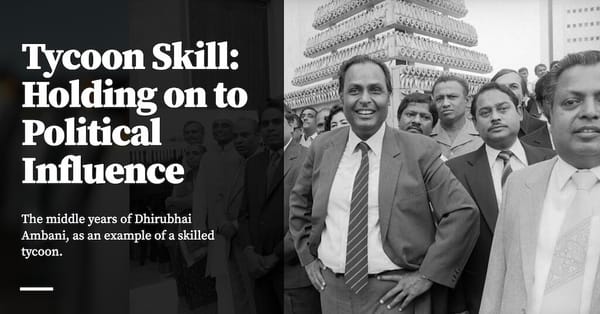
We’re going to talk about first generation tycoon Dhirubhai Ambani of Bombay (and formerly of Gujarat). When we last met him, Dhirubhai had risen to the pinnacle of political influence in India. In this case, we’re going to see him deploy the many, many levers of power available to him to neutralise an opponent:

This is the final case of the Asian Conglomerate Series. We may, of course, add new cases to the concept sequence in the case library. But this case marks the end of this series, where we develop concepts together.
As usual, you’ll want to read the case above first in order to form your own opinions; some brief observations follow.
Observations
Before we start, I want to note that this Ambani case was harder than usual to produce. Ambani’s feud with Wadia lasts for many more years after the events in this case concludes; this is but one of the early skirmishes in their tussle for dominance. It eventually ends with an (alleged) assassination plot on Wadia’s life. The full story is too long, too sordid, and involves too many characters across multiple businesses, cities, government agencies and political parties to be able to render in full here.
If you want the full story, read The Polyester Prince. It’s easy to get a copy: multiple bootleg copies abound on the Internet, a direct result of its ban from India.
Why did we close with this case, then? As a result of the complexity of India’s political system, I believe that Dhirubhai Ambani is the most skilled at this ‘maintaining control of political advantage’ aspect of tycoon skill. There are many stories of political influence scattered across many tycoon biographies, if you know how to look. But only The Polyester Prince portrays the machinations of corruption in such detail, across so many layers of government, over the course of so many decades: a testament to India’s leaky bureaucracy, the sheer number of players Ambani touched in his decades of business, and McDonald’s perseverance on the ground.
At the end of The Polyester Prince, I told a friend that: first, never before had I so wished for a tycoon to lose (but Ambani doesn’t lose, he survives and wins, repeatedly). Second, I said that following Ambani’s moves felt a bit like finishing a season of Game of Thrones. Dhirubhai’s ability to navigate the complex corridors of power in India — and his ability to survive and thrive amidst the various random political assassinations that impact his political calculations — must be read to believe. By contrast, Robert Kuok had it easy in Malaysia; Stanley Ho was positively relaxing in Macau and Hong Kong; of the tycoons that we’ve covered in this series, only B.C. Lee of Samsung faced anything approaching Dhirubhai’s challenges with government. (And even then you could say he had it easy: political influence in a military dictatorship, in a country of ~25 million people, is a lot simpler than political influence in a decentralised democracy of ~600 million).
You could say that the only tycoons who might match Dhirubhai’s track record are the Indonesian tycoons that we met in passing in the Kuok cases, but even then no Indonesian tycoon (that I know of) is as dominant or as successful as the Indian patriarch.
Anyway, I wouldn’t recommend spending too much time digging into such stories. (Unless, of course, you are an Asian businessperson and you intend to bribe your way to success — in which case I have a membership subscription consulting package to sell you ... I am joking). I digress. I’m closing the series with this case for the sake of completion: I wanted to give you one complex instantiation of this aspect of tycoon skill. Between Stanley Ho, Robert Kuok, and Dhirubhai Ambani, you should be able to read other cases of tycoon business and make sense of them in this way.
It goes without saying that you may read this case through the lens of ‘Power in Business’. But this case on Ambani was interesting to me for one other reason. You get the sense that Dhirubhai barely has his influence over government under control. One of the nice side effects of a democracy in a large nation is that checks and balances ... actually exist! It’s just that in the case of India, the checks and balances take the form of the many layers of government that one has to bribe. All you need is one person in one government agency who disagrees, and your carefully constructed edifice of control slips from your grasp. Over the course of The Polyester Prince, it becomes clearer and clearer as the years pass how difficult it is to hold on to political influence in the nation.
Perhaps there’s hope yet.
There will be one more essay in the Asian Conglomerate Series. We’ve gone on a long journey together. It’s time to wrap up.
This is Part 16 of The Asian Conglomerate Series. You may read Part 17 here: “This One Can Make Money Or Not?”
Originally published , last updated .
This article is part of the Operations topic cluster, which belongs to the Business Expertise Triad. Read more from this topic here→
Ideas and cases to accelerate business expertise
Commoncog is a publication dedicated to the serious study of business.
We are businesspeople serving other businesspeople. We develop methods to build business expertise, faster.
Your time is valuable. We publish only what we think is useful, tested, and good.
Sign up to receive our latest writing: