
Two weeks ago John Schmitt ran a Tactical Decision Game (TDG) for Commoncog members. A TDG is an accelerated expertise training method Schmitt developed for the US Marine Corps more than 30 years ago. It’s still widely used — in fact it is one of the primary pedagogical methods across all of the Corps’ schools. For most participants who attended the session, the TDG was the first accelerated expertise exercise they’ve ever experienced.
If you’re a Commoncog member you may read the reactions in the forums here. You may also want to watch the full recording, which is available behind the paywall here. Overall, a) it was incredibly stressful, and b) it was a total blast. As I’ve mentioned during the call and elsewhere, I intend to adapt these methods to business scenarios, of the type that we publish in the Commoncog Case Library, in order to accelerate business expertise. This in many ways is Commoncog’s goal — and I’m willing to throw resources at it until we get there.
In this piece, I want to talk a little about why TDGs work so well, and how it accelerates expertise. If you’ve watched the video, you may have caught some of these ideas in the debrief (which takes place in the second hour of the recording). And if you’re a long time Commoncog reader, you may recognise:
- How the exercise teaches you what cues, expectancies, goals, and actions are available to you in the scenario. These four elements, of course, are the four by-products of the ‘recognition-primed decision making model’ — or RPD, which is a descriptive model of expert intuition.
- You may also have noticed how the exercise forces you to engage in repeated frame construction as you’re making sense of the situation — which we’ve covered in our essay on How Experts Sensemake.
- Most importantly, however, you may have noticed that as you construct multiple frames repeatedly over the course of the exercise, you are building the ability to deal with scenarios you’ve never seen before — which is why the TDG is such a suitable training method for an ill-structured domain (that is, a domain where things are constantly changing). What this feels like is — as expertise researcher Jared Peterson puts it — “at the end of the exercise, you should feel like your common sense has improved.”
This essay will take all the ideas that we discussed in the lead-up and in the debrief of the session, so you have one document you may refer to if you’d like to build a training program on top of the same principles.
Why is This Important?
First, though, why is understanding these principles so important?
The glib, of-this-moment answer is that AI has arrived, AI is changing the world, and you want to get better because folks with domain expertise use AI better than those without. It is observably true that 2026-era AI-use tends to be an accelerant for those who are already good in their domains. This means learning the principles of expertise acceleration will make you better faster, which should allow you to use AI better in the near future.
Which, sure, fine. The above reason may or may not age well depending on how the technology evolves over the next few decades. So let’s set this aside for now and turn to more timeless reasons.
A slightly longer answer is that expertise acceleration methods help you become more adaptable. This is more profound than first meets the eye, and relies on several findings that are still not widely appreciated.
To summarise quickly:
- It’s only within the past decade that we have learnt the highest form of expertise is adaptive expertise. To put this another way: compared to novices, experts are better able to deal with situations nobody has seen before. This ability to handle novelty is a better signal of overall skill as compared to fluid performance on more ordinary tasks. This is a really big deal, because …
- We have learnt that designing training programs for adaptive expertise also happens to speed up the rate at which you gain expertise. All of the methods in the 2016 book Accelerated Expertise target adaptive expertise directly. More recently, folks are starting to realise that exercises that vary constraints produce better outcomes than more traditional ‘deliberate practice’ type methods. See, for instance, this widely cited New York Times article about the Constraints-Led Approach, or CLA, which is currently being adopted by top-tier sports teams across multiple sports leagues. CLA also targets adaptive expertise directly.
- Contrary to popular belief, training methods like Deliberate Practice (or the structured, hierarchy-based practice methods taught to us in schools) do not help with adaptive expertise — and in fact some evidence suggests that it worsens performance on adaptive tasks. The implication here is that DP accelerates expertise only to a journeymen level in ill-structured domains, and works best when the domain is gentle and well-structured. I’ve said in the past that I’ll write a longer essay on this, and I will, but not now.
- Anyway, all of the above means that …
Training for adaptive expertise matters in domains where you’re always facing novel things. The type of training that TDGs give you is exactly the type of training that works for a wicked, constantly evolving domain — which, well, it should, since war is wicked and constantly evolving. I believe that if you internalise the principles that TDGs are built on, you’re more capable of designing training that’s useful for a constantly changing environment. This seems useful … whether or not you believe AI actually changes things for your specific context.
Many of the participants present in the session seemed interested in adapting TDGs for use in their own business environments. Since the vast majority of businesses operate in an environment that is constantly changing, this seems like a natural fit.
What’s a TDG like?
For those of you who aren’t Commoncog members, a TDG works like this:
The facilitator opens a slide deck. The deck usually has no more than three to four slides. You’re presented with three rules in the first slide. The rules are:
- If you’re in the room, you’re in the game. There are no observers in a TDG.
- All decisions in the form of the orders you will issue. We want your orders in response to the situation. You may explain why you issued those orders later.
- Leave your rank at the door. This is more important for military or corporate environments — everyone is the same in a TDG because the goal is learning; there is no special preference for or deference to rank.
The facilitator then moves on to the second slide.
The second slide presents an unfolding scenario. I’ll quote from a publicly available military scenario here. Don’t worry if you don’t understand the terminology — just about all the participants in Commoncog’s TDG session with Schmitt were civilians, and Schmitt gave us a military scenario as well, since that was what he was most familiar with. We didn’t understand much of the terminology and asked a lot of dumb questions!
(If you’d like, feel free to paste the passage below into Claude or ChatGPT with the prompt “I am a civilian. The following passage is taken from a tactical decision game found at https://warfighters.substack.com/p/picket-duty. I don’t understand the military terminology so break it down for me.”)
Note that in an actual TDG, the set up is read aloud. Unlike with reading text on a page, you can’t pause and go back in time to reread certain sentences or think through the implications of certain instructions. And so the experience of sitting in a TDG is pretty much that of information overload for the first few minutes, with the sure knowledge that in a few more minutes the facilitator may call on YOU to give your orders.
Yikes!
Here’s the example scenario:
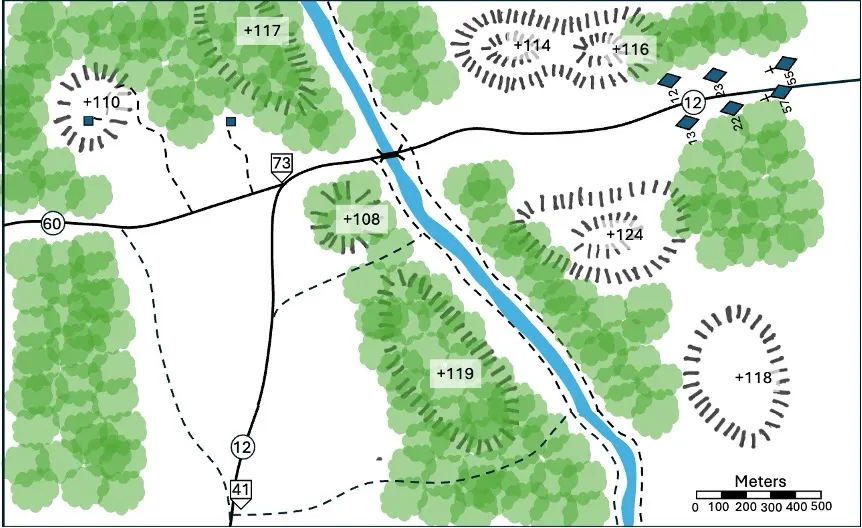
You are an armored reconnaissance platoon commander conducting a screen/reconnaissance mission in the security area forward of the main defensive positions. Your platoon is equipped with four lightly armored, wheeled vehicles with excellent road and cross-country mobility. Your vehicles are armed with a 25mm chain gun (r: 2500m) that fires HE and antitank rounds. You are organized into two sections: 1st Section is Vehicle 12 (your vehicle) and Vehicle 13; 2nd Section (led by your platoon sergeant) is Vehicles 22 and 23. You have an FO with you in your vehicle but no scout team. Vehicles 13, 22 and 23 each have a 4-man scout team armed with automatic weapons and AT-4s. You have been reinforced with a section of two assault gun variants (Vehicles 55 and 57) armed with a 90mm main gun (r: 3000m) that fires both HE and antitank rounds. The AGs have no dismount scouts. There is an artillery battery in direct support of the company, but for much of your mission you will be out of range. The wooded areas prohibit vehicular movement, except on trails, but otherwise you can move freely, including the hills, which provide no obstacle.
The division has gone into an operational pause and has established defensive positions some 10 kilometers east of the map, with plans to resume the offensive, attacking west within the next week. For the last two weeks, your company has been operating in the contested zone known as the security area forward of the main battle positions, where you are conducting armed reconnaissance and screening missions. It is not uncommon to make contact with enemy forces performing similar missions. Your mission for the day is to conduct a motorized security patrol along a designated route in order to locate and provide intelligence/early warning of enemy activity in your sector. Your independent mission gives you wide latitude in how you accomplish it. Your orders require you to gather intelligence and provide early warning of enemy activity, but they do not require you to provide physical protection for the main body, although you can engage the enemy at your own discretion as long as you do not become decisively engaged. The other platoons of your company are performing similar missions to the north and south of you and can reinforce you in about 30 minutes. Attack helicopters are on-call and can arrive on station in about 20 minutes.
Your route will take you west along Rte. 12 to Checkpoint 73 and then south past Checkpoint 41 for 10 kilometers before returning east to friendly positions. As you move west toward Checkpoint 73, you come to a stream that you determine would be easily fordable even if there were no bridge. Your section moves forward toward Checkpoint 73 while 2nd Section and the Assault Gun Section remain in overwatch. At Checkpoint 73, Rte. 12 turns south into a large opening that extends south and west for several kilometers. You dismount and move forward to have a look. About 1500 meters south on Rte. 12 you spot an enemy column moving north. You count 8 vehicles so far, which you can positively identify—five armored cars with 23mm guns and three 6-wheeled vehicles with 73mm guns. They seem to be moving in a staggered column. At this rate you estimate they will arrive in less than 10 minutes. It is 1700 hours.
At this point the facilitator will stop, and say to the room: “do you have any questions?”
This bit is very important. In a previous TDG exercise with Commoncog members, NDM researcher Jared Peterson (who was facilitating for us) told us that this question-asking phase allows participants to begin making sense of the situation. After all: what you ask reveals to others what you’re noticing and what you’re thinking about.
At this point, the facilitator would sit back and answer questions, taking care not to reveal more information than necessary. I suspect the other reason for this pause is so that everyone can wrap their heads around the sheer amount of information just given to us.
Initially, the questions can be quite trivial. For instance, if someone asks “can the enemy column see my section right now?” The facilitator might answer: “well, you’re dismounted and in the tree line so you assume they haven’t spotted you yet. But if you can see their vehicles, you’d have to assume that they will be able to see yours if you order your vehicles to proceed further along Route 12.”
Or: “do we know if they have more backup coming?” The facilitator will likely say, “We don’t know that.”
“Can we expect them to fire on us?” A: “We’re in a contested zone. Yes.”
And so on.
During our session, Schmitt said — in response to a participant: “That’s a very interesting question, what makes you ask that?” Which made me pause to listen to the participant’s answer. That answer informed my own view of the scenario.
After about 15 minutes of this, the facilitator will begin calling on individual participants to give their orders. For instance: “Mary, your orders please.” And then after Mary responds, the facilitator might ask for her reasoning: “What’s your thinking here?”
Mary will respond, at which point someone else in the group might jump in with: “No, that can’t possibly work, because …” and the facilitator may turn their attention to this new person. “Ok, that’s valid. Give me your orders, then.”
Meanwhile everyone is watching, and asking questions, and jumping in when they have something to say.
What’s happening when this is going on?
With each question or response you will automatically feel your frame shift. Recall that human beings make sense of data only in the context of a frame. What frame you use informs which pieces of data you notice; which pieces of data you notice informs the frame you construct.
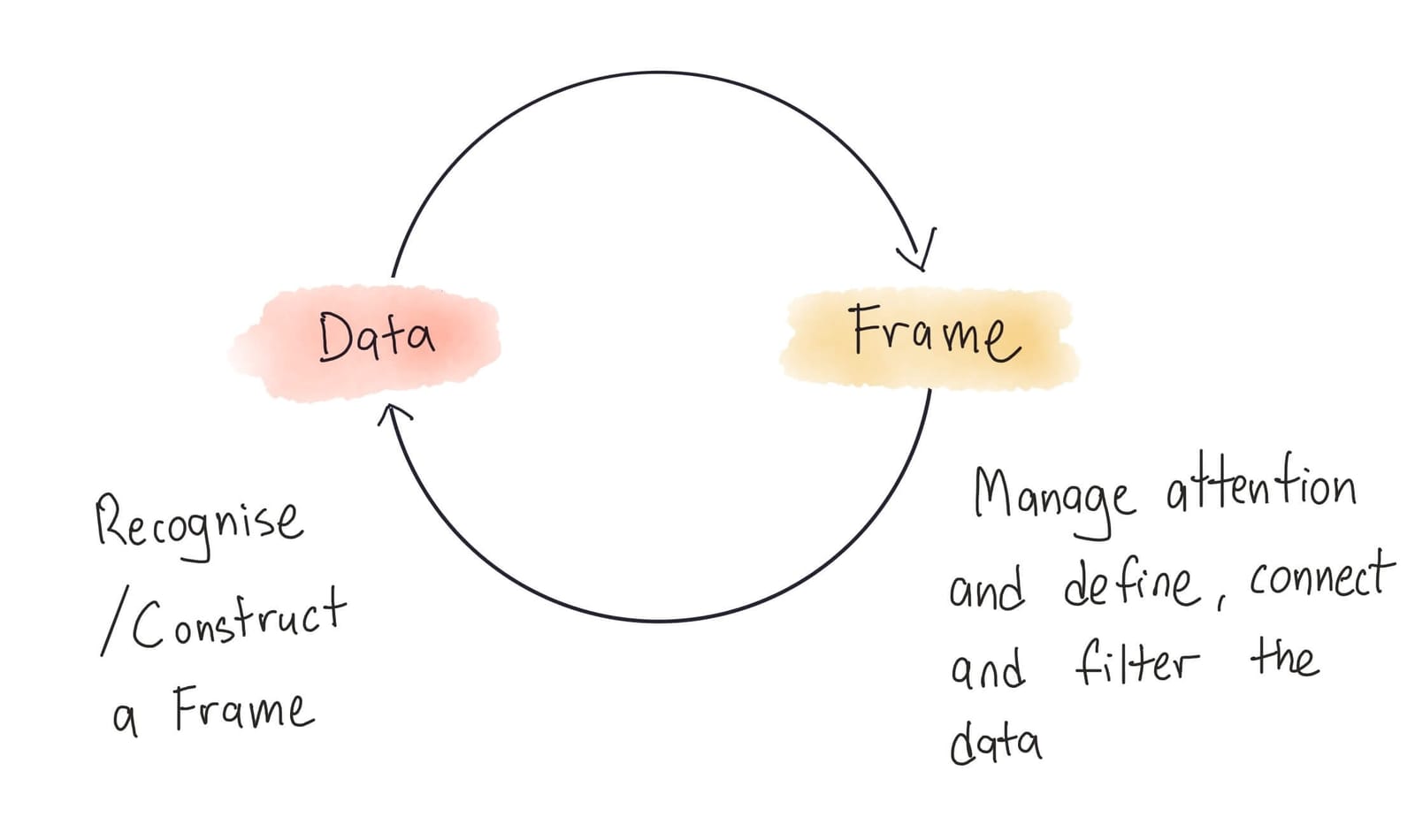
So for instance, if another participant says: “I’m afraid that the column will dismount, ford the stream, and attack me through the tree line from the direction of hill 119” suddenly you’ll be thinking about that possibility and incorporating it into your own plans.
Then another participant says: “Why would they do that? They don’t know we’re there, do they?” And you reconsider again. You can’t help yourself; this is what human brains do.
The things that you find most important to pay attention to will suddenly seem less important once someone else raises a possibility you haven’t thought of. The important thing is that you’re experiencing all of these frames and reframes at the speed of a normal conversation.
Note that a good facilitator will never say “that’s a stupid idea, try again.” Instead they will ask “ok, that’s interesting, what are you thinking there?” and let the collective sensemaking of the participants either accept or reject the idea.
After a couple minutes of this, the facilitator will pounce on something that a participant says that happens to coincide with the ‘best’ decision, expand on it, and then advance the scenario to the next slide.
In more unusual circumstances (say, if a participant proposes a particularly intriguing development) the facilitator may let the alternative scenario develop in parallel, and ask for decisions in both the scenarios.
The scenario may continue with one to three more ‘developments’, contingent on the time available. It concludes with the presentation of the ‘best’ final decision by the facilitator. Usually the ‘best decision’ is one that was developed by skilled past participants. If the scenario is a completely new one, the ‘best decision’ is whatever the group agrees is the best set of orders during the exercise. It is for this reason it is helpful to have at least one (if not more!) skilled participants when presenting a TDG for the first time.
Why This Works
What is the learning objective here? What is accomplished with such an exercise?
Also: why does it accelerate expertise?
There are a few goals to a TDG, but the primary one is to improve your sensemaking. Recall the insight that we discussed several months ago: Sensemaking as the Heart of Expertise. I wrote:
The core idea is ridiculously simple.
- Experts can see things that novices can’t.
- If you can teach novices to see the domain like the experts, you will accelerate expertise.
That’s it. That’s the entire shebang in two sentences.
A TDG is a way to teach novices to see the domain like the experts. At the end of that essay I proposed a demonstration of the technique. I said to read a bunch of Commoncog cases, and then:
- Record your reaction to the case as a voice note.
- Listen to my case reaction, embedded as a recording at the bottom of the case.
- Reflect on the differences between what I saw and what you saw.
The TDG does this, but on steroids. Throughout the exercise you’re constantly attempting to make sense of the situation … and you’re incorporating the perspective (frames) of all the other participants as you do so. This is much faster than if you’re trying to make sense of the situation yourself. Perhaps you’ve already felt this. If you attempted to answer the scenario I presented you above, you’d have struggled with:
- What to pay attention to
- What’s likely to happen next?
- What goals are most important
- What set of possible actions are available to you?
Notably, your brain will pick up possible answers to all four of these questions whenever another participant asks a question or proposes an answer.
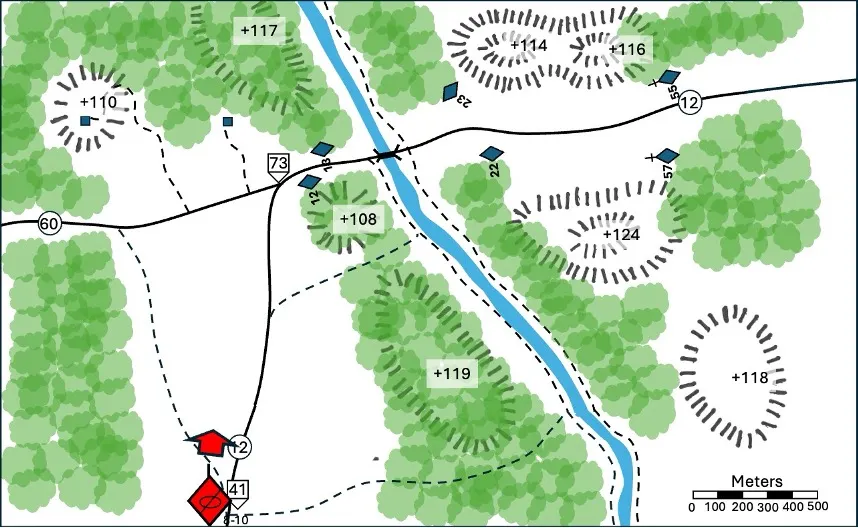
For instance, if someone says: “You know, if the enemy turns left at the checkpoint 73, we’re safe, since they’re going to be moving away from us. But if they turn right, we’re screwed!” This is an expectancy: it is an attempt to predict what’s going to happen next. If you hear this during a TDG, it’s very likely that you’re going to incorporate this piece of information into your frame.
And then if someone says “I want to call in to higher (Marine Corps shorthand for ‘Higher Headquarters’) that an enemy column is approaching us” and another person says in response: “Dude, that column is just 10 minutes away! Reporting can wait; orders now!” That’s an explicit declaration of goal prioritisation right there, and it’s also likely to be incorporated into your sensemaking.
I want to emphasise that I’m breaking this down for you right now, but when you’re experiencing this for yourself, everything happens automatically. Nobody has to tell you “oh, you’re incorporating Jack’s prioritisation into your brain” or “you’re taking Mary’s expectancies into account.” It all happens smoothly, invisibly, because the exercise exploits how the human brain already works. You’re taking in all this information, judging how important it is, and adjusting your plans in response.
Sharp-eyed readers might also have noticed that I’m talking about expert intuition here. Specifically, I’m talking about the Recognition Primed Decision Making model (RPD) — which is a descriptive model of expert intuition:
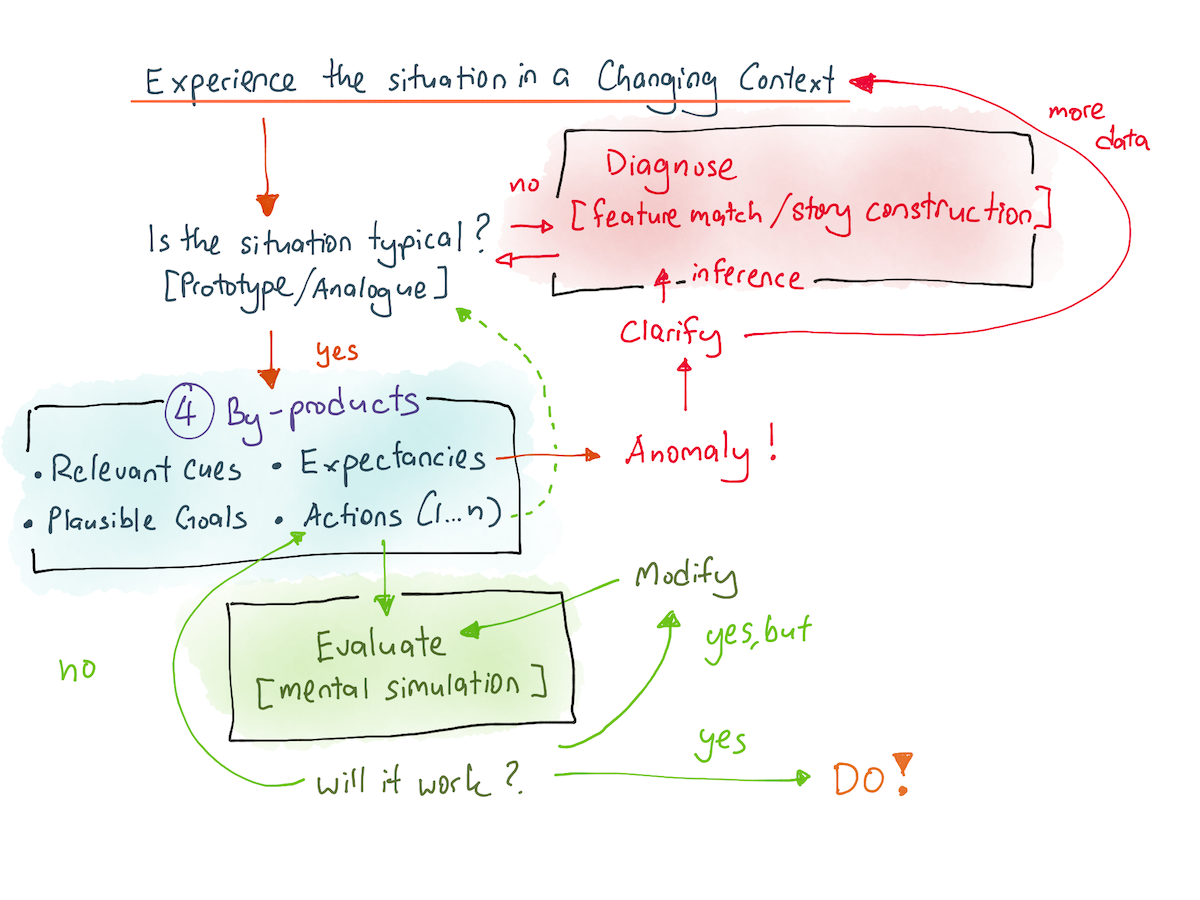
Here’s a quick recap of RPD. When looking at a situation, expert intuition automatically produces four by-products:
- Cues (what to pay attention to)
- Expectancies (what’s going to happen next)
- A prioritised list of goals (what’s most important to find out or accomplish first)
- An action script (a set of actions to do in response to the expert’s assessment of the situation).
The thing to know about this model is that the human brain generates these four elements quickly, so quickly that most people will find it incredibly difficult to describe how they know what they know. This is not surprising: such recognition happens in implicit memory — the same part of the brain where face recognition occurs.
It is highly likely that you already do this yourself. Think about a domain where you have some expertise. You’re going to look at a situation in that domain and your brain will automatically generate these four elements for you. What it feels like is that suddenly, you just know what to do.
The example I like to use is driving a car, which is a form of expertise that most of us have. When you’re about to make a turn at an intersection, for instance, there are actually a ton of things that you have to take into account that a novice driver would struggle with. And yet you take the turn automatically. Why? Well, that’s because you have expertise: you know what to look at, what might happen if another car or motorbike appears, what to prioritise when a goat walks onto the road, and what complex series of driving actions you have to take to execute the turn successfully and safely. This is expertise in action.
Now you might be reading this and think, “Ok, so all I have to do is to explicate the four elements that an expert generates for this specific situation, and I can put this on a slide and teach this to students!” Or you might think: “Aha! I can explicate this for everyone and teach this to an AI model!”
Not so fast. There’s another thing that’s going on in your head.
Notice that you can adapt on the fly when you’re executing a turn at an intersection. Let’s say that I take you from where you normally drive, and drop you onto a mountain pass in Pakistan, and I tell you to make a left turn at an intersection over a cliff, right as a flock of sheep crosses the road. You’re (probably) not going to miss a beat. As far as novel situations go, you may not have dealt with this exact situation before, but it is not a particularly difficult one: your brain will continue to generate the right set of by-products so that you can deal with the situation.
(If you’re dealing with a stampede of mountain goats this might be a completely different matter, but I digress …)
The point I’m making is that humans are naturally adaptable. And we are able to adapt because the human brain generates the four elements within a frame that it constructs to make sense of the situation. In the case of the sheep example, you:
- Know what to notice when making a turn at an intersection.
- Notice that the sheep might be making the crossing as you’re approaching the turn.
- Know that if you hit sheep you’re not going to die, but you’re likely going to get into trouble with the shepherd.
- Can predict how quickly the sheep is going to move, but also know that you don’t want to be in the way of other cars coming from the other direction of the main road you’re currently on.
- And so on.
Your brain constructs the frame for this specific situation from fragments of what it already knows, uses it to make sense of what’s going on, and then adapts your goals and actions to fit the situation. In my essay on the best theory we have on sensemaking, I said that the best way to improve your frame construction abilities is to give you new fragments that you may use to construct new frames in the future.
Now let’s bring this back to the TDG:
- “The enemy is going to turn left at the intersection, away from us, or right, towards us” is a fragment that changes the way you think about the situation. It teaches you “I have to think from the perspective of the enemy”
- “Orders first, report later” is another fragment. The takeaway might be “in time-sensitive situations, I should issue orders first, report to higher later.”
But notice how this information is presented. It’s not presented as a framework, or as an abstract piece of information on a PowerPoint slide. Instead it’s presented in use, in the context of a case, under conditions similar to that of the decision making you’ll have to do on a real battlefield.
When someone says “in time sensitive situations: orders first, reports later”, you are teaching an idea without the context to be able to use it. After all, what counts as a ‘time sensitive situation’? In some battlefield scenarios, it is more important to report to higher first, before issuing orders to your platoon. What are those scenarios? How do you recognise them?
Experts do not have strict rules or frameworks when evaluating such things. (Sure, they may come up with a list of properties if you push them, but this is not how they actually make decisions). Instead they decide based on the frames they construct for the situations they are faced with. For instance, an expert commander might construct a frame “I know that we have troops incoming to this position within 20 minutes. If I don’t report this to higher NOW, it may be too late and we’ll walk right into what I suspect might be a trap.” In such a situation they may decide it’s more important to issue a report before issuing platoon orders.
The way to teach this is to get students to experience it, over the course of many TDGs. You’ll be surprised at how quickly they get a ‘feel’ for when to apply rules, and when to break them. In some TDGs, the most skilled commanders may disagree on the right orders to issue. This is useful too: students will pick up on possible alternative frames they may construct, and keep those as fragments for future unique scenarios they will face on the field.
Let me put this in more concrete, technical terms. In order to get you to see the situation like an expert, you’d have to construct frames like the expert would. Frames are constructed from fragments of causal mental models and cases that you’ve seen before. A TDG gives you lots of fragments that you may use to construct frames, at an accelerated rate.
I say accelerated rate for two reasons:
- The TDG compresses time. A real battle may take place over the course of days. A TDG compresses it down into an hour or two.
- The TDG compresses sensemaking. You are exposed to many more sensemaking frames then you would if you were to learn by actual battle. Even wrong ideas may be useful — for instance, a participant may bring up a possible goal or a possible action that is not usable here, but may become useful in a future scenario. You think “huh, that’s interesting” and it will sit as a fragment in your head, to be invoked when you’re creating a frame in the future.
This is why TDGs produce adaptive expertise.
The real goal of a TDG is to get you to become better at frame construction. The better you are at frame construction, the richer your frames, the more capable you will become at dealing with situations you’ve never seen before. This is why Peterson writes that “experts are able to pattern match against scenarios they have never seen before.” Actually let me quote this remarkable bit from his piece on expertise:
Experts are not just generalizing rules, and it is important to understand this because it is what distinguishes humans from AI, and helps to explain why Naturalistic Decision Making is the best approach for studying expertise.
AI learns from generalizing from examples that it assumes will serve as templates for how to handle future situations. This means with AI systems it is incredibly important to train them on a diverse sample of cases that are representative of real life, or the model will overfit from the cases.
Training expertise is not like this. With experts, you can train them on atypical and difficult cases, and they will not generalize that training to the easy cases. You can even train experts from failures, and they will infer the correct thing to do. The reason for this difference is that expertise is fundamentally about pattern matching so that you can discern between situations, not about developing generalizable rules that apply across similar situations. Because of this, experts collect cases, and not principles, rules, or heuristics.
This is important, so let me say it differently; when it comes to training expertise, the cases are the primary thing being relied upon, and not merely examples to explicate generalizable rules. A history of cases to rely on is what allows experts to be more adaptive than if they were merely generalizing, and allows them to create and try new things that no one else has ever done (bold emphasis mine).
TDGs Accelerate Osmosis of Tacit Knowledge
I want to hammer this home, so let me make this argument one other way.
Years ago I wrote a series on tacit knowledge that became very popular. In it, I talked about how tacit knowledge tends to get transmitted through apprenticeship under a master, where the mechanism was ‘osmosis’.
But what, exactly, is osmosis? How does it work?
Well, I’ve just given you the answer: osmosis works because you learn to see like the master. You see cues and expectancies, generate goals and come up with actions like the master would. Over the course of your apprenticeship, you will see lots of cases. You will notice the hundreds of little decisions that your master makes when approaching new projects, and eventually build up your own experience base of cases that allow you to construct effective frames of your own. Because your frames mirror your master’s, your initial taste or judgment derives from theirs. It’s common to notice similarities in the work of an artist, or architect, or craftsman, who trained under another for a long period.
Take furniture making, for instance. My friend Vaughn Tan writes beautifully about the nature of (one type) of tacit expertise in furniture making. First, he sets up what the novice sees:
Trees are not Platonic solids. A tree grows irregularly, depending on the slope of the land it’s on, how much rain it gets, whether it was shaded, whether an insect bored into it, and innumerable other factors. Bacteria, fungi, and the drying process affect the shape and appearance of wood in unpredictable ways. Raw lumber milled out from a tree is highly irregular — it is very much not a Platonic solid either (hence “crooked timber” as a metaphor for human imperfectness).
I processed the raw material for my first project (a simple set of folding shelves — it was a training wheels project) to remove as many imperfections as I could. Knots, strange grain, odd colour; I tried to get rid of as much of it as possible. With mild resentment, I adapted the design around unavoidable imperfections in the wood.
This is how almost all novices and the vast majority of experienced furnituremakers approach raw processing of lumber. It’s conceptually much easier to approach a project deterministically like this: Come up with a design plan for the piece in advance, get the material, process it to get rid of whatever the design does not envisage so the design can be accurately implemented — change the design if forced to by unavoidable imperfections in the material.
And then he talks about the tacit expertise that master furniture makers have:
In the meantime, John lent me his copy of The Impractical Cabinetmaker by James Krenov, who taught at the College of the Redwoods at the far northern end of California. This book brings the reader through three of Krenov’s furniture projects. These are, in my view, only a pretext for illustrating a different approach to working with wood.
The essence of this alternative approach is not to start by coming up with a design, then imposing that design on the raw materials. One of his students at the College of the Redwoods relates how Krenov talked through his approach to designing and constructing: “He allowed his eye to determine the proper dimensions, proportions and details for the particular type and character of wood that he was using. Jim [Krenov] didn’t work from a drawing — rather, he designed and built on the fly, by ‘composing.’”
The alternative approach to wood actively considers the raw material (including any irregularities and imperfections) and designs in a way that profits from what is there, irregularities and all. The design is provisional, continually evolving in response to learning more about the material.
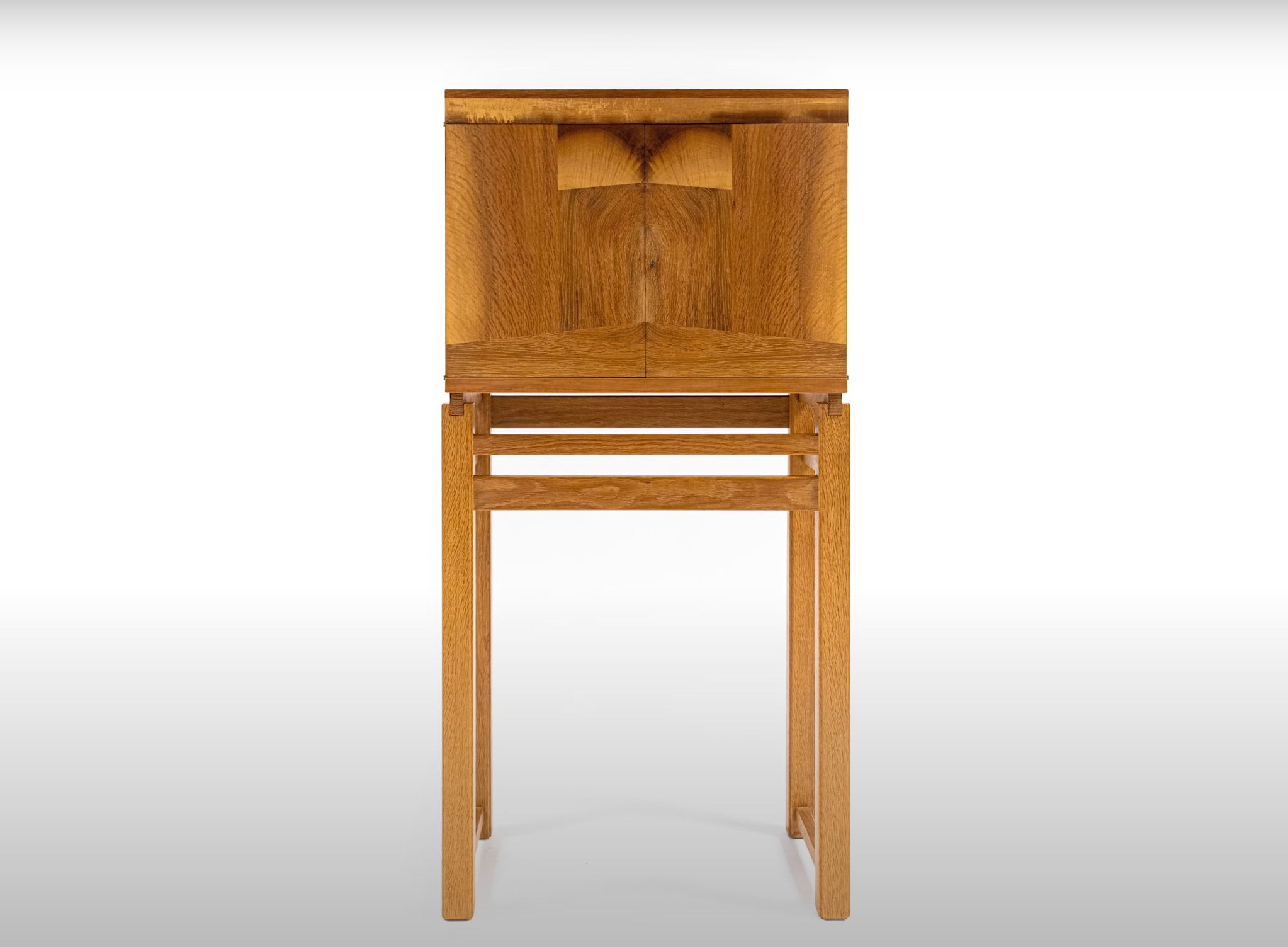
The parquetry cabinet of white oak and Mendocino cypress above was made by Krenov in 1997 (the photo is from the Krenov Foundation). As with his other work, the finished product shows the the effect of approaching the wood with the intent of understanding it (imperfection and all) as opportunity. High-contrast irregular wood grain is often considered a liability because it is visually distracting. Uniform grain is prized because it is a material that does not compete with the design it is used to construct. In Krenov’s cabinet, the extremely high-contrast grain is not a liability. Instead, it has become the core design detail (on the top and front doors) that orients the flow of the rest of the cabinet.
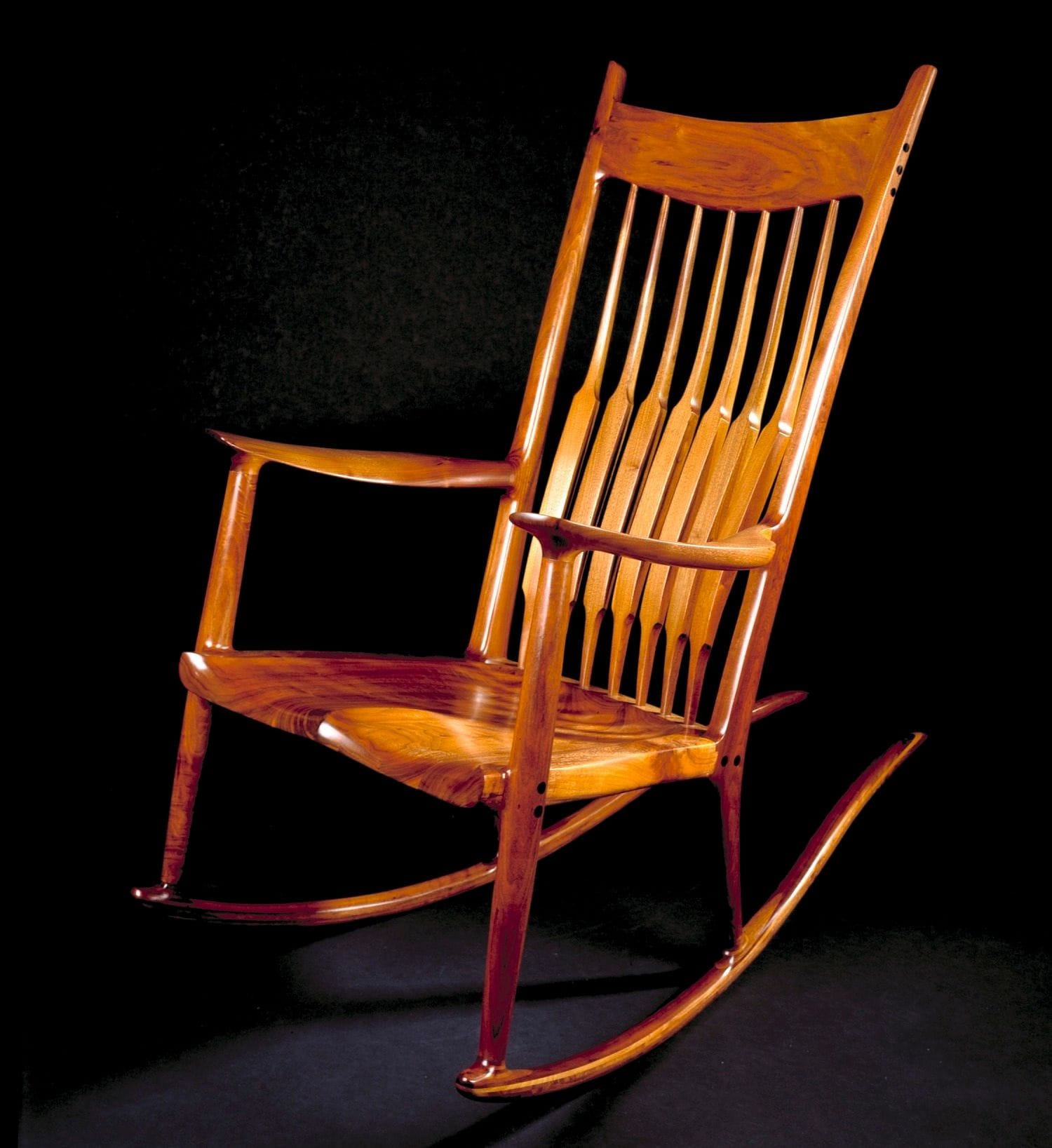
Other master furnituremakers like George Nakashima, Sam Maloof, and Wharton Esherick — and John Grew-Sheridan — seem to have worked in a similar way, allowing design and material to be in mutually productive conversation.
With this approach, two things stand out about how the maker relates to the material and the work to be done. First, the maker is intentionally open to what is actually there. Second, the maker is actively working to understand and appreciate the material’s affordances. Third, and most important, the maker resists the urge to predefine aspects of the material as imperfection or irregularity, so that things that would otherwise be considered a liability or constraint may be interpreted as resource and opportunity instead.
Furniture made with this alternative approach feels different, alive.
The problem with osmosis and apprenticeship is that it takes time — years. In some crafts domains, decades. And the reason for this is that you’re collecting cases (and observing frames) only as quickly as your master can execute on projects. How many projects can a master furniture maker do in a single year? Or an architect? And how many of them are difficult — and therefore educationally useful?
TDGs — and other accelerated expertise methods — accelerate osmosis because they focus on the core mechanism through which osmosis works: frame construction in the face of difficult cases. The more difficult cases you are forced to sensemake with the master, the better you become. The faster I can get you to see like the master, the faster you’ll become good.
Other Benefits
Are there other benefits to TDGs? Yes. During the session with Schmitt, multiple participants noticed just how hard he was on us on the way we were giving our orders.
This makes sense. In a military context, misunderstanding is a matter of life and death. Communication skills are thus an important part of a military TDG. Schmitt would correct us as we were giving our orders. Later in the session he would clarify that good orders included an element of ‘situational awareness’ (“here’s the current situation as I see it”) and ‘commander’s intent’ (“this is why I want you to do this”). That way, if our soldiers arrived at a different part of the battlefield and found that things had changed, they would still be able to improvise to achieve the intent of the orders, through methods of their own devising.
I also asked Schmitt if the Marines used TDGs to evaluate soldiers. He answered yes, though not in an official manner. He said that if he were running a TDG with his platoon, he would pay special attention to how his soldiers were making sense of the situation: what questions they were asking, what orders they were issuing? He would also notice if they were improving over time, over the course of many TDGs. This information was useful: it would inform who he delegated which tasks to and how he phrased his orders to specific people when he was in the field.
The ideal outcome, of course, was a platoon that was so integrated they could operate as one mind. This required a level of shared sensemaking that is quite difficult to achieve.
Schmitt has written publicly that he cares a lot about the cognitive fidelity of the training, not necessarily the physical fidelity. We used crudely drawn maps in our TDG (as you can see from the example above). But this didn’t matter — the decision making that participants had to do in the game feels very similar to the types of thinking you would have to do in the midst of battle. To my mind, there is no reason why similar exercises can’t be developed for business or for investing, even though business and investing occur over longer time periods. (I often joke that business is the ‘greatest board game ever invented’, where the length of a turn is a day).
There is one final benefit, and a Commoncog member who participated in the TDG with Schmitt articulated it in the forums later. We use Chatham House rules in the forum, so I’ll quote this without revealing who it was:
I do want to add my 2 cents about the visceral nature of goals in real situations. For example, John pointed out the importance of goal prioritization (…). I was thinking that everyone knows and understands the importance of prioritizing the goals. But what it really means in a real situation where you are emotionally invested and are under time pressure is something that can (probably) only be experienced, and just “understanding” it is not the complete picture when it comes to internalization.
Here, the larger goal of peacekeeping was made clear to us from the very beginning. And objectively speaking, many had indeed identified that the attack from the top right needed to be countered because of this. But dropping the stated goal of (…) as part of “goal prioritization” felt very visceral, in the moment.
This is one aspect I have struggled with in my domain as well. When it comes to some non-technical concepts or some technical but higher-level strategic concepts, just knowing or understanding isn’t enough. There is a lot of mental resistance to actually applying them in real situations. I have observed that people only really learn these things once they see the consequences of their actions after ignoring advice being communicated to them when the event was happening.
I have been thinking for a while about how to solve this problem, as it’s not possible to spend years making every possible mistake and actually “feeling” the lessons. TDG exercises definitely seem to be a candidate solution here.
I wonder if this also connects to the accelerated learning aspect (TDG exercises, obviously, help in accelerated learning, but I am referring to this specific form of internalization). Can we make people learn faster by actually making them experience business concepts and strategies playing out and the consequences of their decisions in a way that is emotionally charged, even if simulated? (emphasis mine)
To which I responded:
Oh, absolutely! This is exactly what TDGs (and the theory underpinning them — Cognitive Transformation Theory) is meant to do. There’s a whole paper with the title ‘New Approaches to Instruction: Why Wisdom Cannot Be Told’ that I did a forum topic about, and TDGs (and other NDM style training methods) are supposed to solve exactly this ‘wisdom can’t be told’ problem.
You may have to experience this for yourself to believe it.
Wrapping Up
I want to emphasise again that everything in this essay is completely unnecessary if you’re a participant in one of these TDGs. You do not need to be told “you are picking up cues, expectancies, priorities, and possible actions”. Nobody needs to explain to you “I’m giving you fragments for frame construction later.” All of this will happen automatically, because all of these elements exploit the way the human brain already works.
The purpose of this essay is to tell you why it works, so that you may adapt these methods to your own domain. In fact, folks who have participated in Commoncog’s course Speedrunning the Idea Maze are likely to notice many of these principles present in the design of the course, albeit in a completely different format. That course was built to teach students to ‘see reality like an entrepreneur’. I think it worked.
There’s a lot of talk today about ‘taste’ and ‘judgment’ in the face of ever-advancing AI. There’s not as much talk about how to reliably build said taste and judgment. Or how to do it in an accelerated fashion. I hope this piece gives you some ideas.
Production note: Special thanks to John Schmitt and Jared Peterson for doing TDGs with Commoncog’s community. All mistakes in this essay are mine.
As I mentioned earlier, Commoncog members are very interested in adapting TDGs to business. I’ve said that I will commit resources to this effort until we’ve built something that works. If you’re a Commoncog member, much of that experimentation will be made available to you as part of your membership. Unfortunately, TDG sessions are capped at 20 participants each. If you missed the last one, you may watch the recording here, or wait for the next session. See you at the next one!
Originally published , last updated .
This article is part of the Expertise Acceleration topic cluster. Read more from this topic here→
Ideas and cases to accelerate business expertise
Commoncog is a publication dedicated to the serious study of business.
We are businesspeople serving other businesspeople. We develop methods to build business expertise, faster.
Your time is valuable. We publish only what we think is useful, tested, and good.
Sign up to receive our latest writing: